

Copenhagen, Denmark: Energy and the Environment, Health and Well-being
Program Dates 2027
| Arrival | August 14, 2027 |
|---|---|
| Classes Start | August 19, 2027 |
| Classes End and Departure | December 10, 2027 |
Program Dates 2026
| Arrival | August 15, 2026 |
|---|---|
| Classes Start | August 20, 2026 |
| Classes End and Departure | December 10, 2026 |
Costs and Financial Aid
The total cost of the program for Fall 2027 is $30,735 and includes all registration fees and tuition, overseas insurance, flights, passport, visa, pre-departure costs, housing, excursions, meals, and estimated personal expenses during the semester abroad.
You will be able to apply for federal and institutional financial aid to cover a portion or all costs of this program.
Application
The application for Fall 2027 will open on August 1, 2026. You must indicate your interest in this program on your UT Austin application. You will then receive a supplementary application in your MyStatus portal. The deadline to apply to UT Austin is December 1, 2026 and the supplemental application for Take the World by the Horns must be received by December 10, 2026.


Health and Well-being
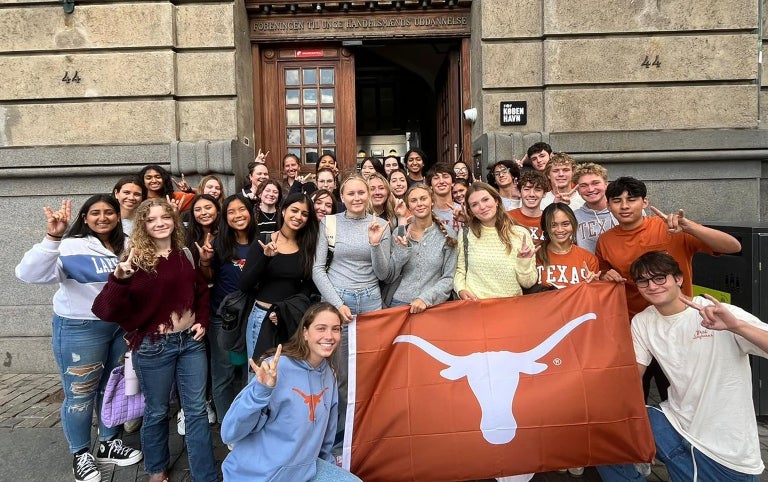
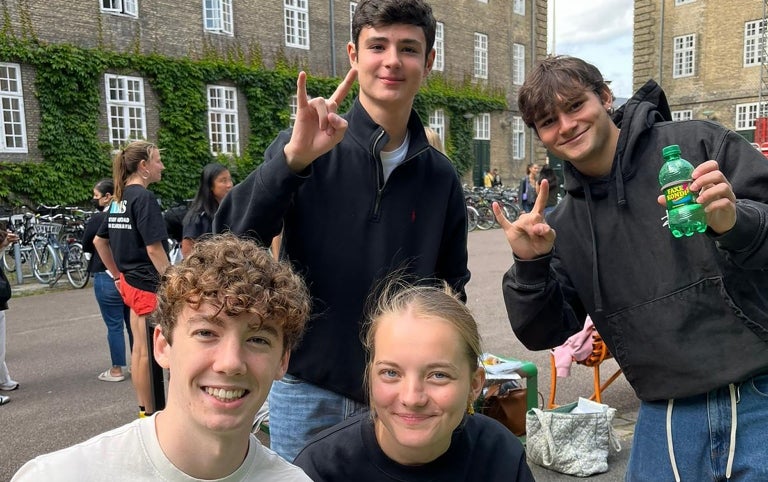
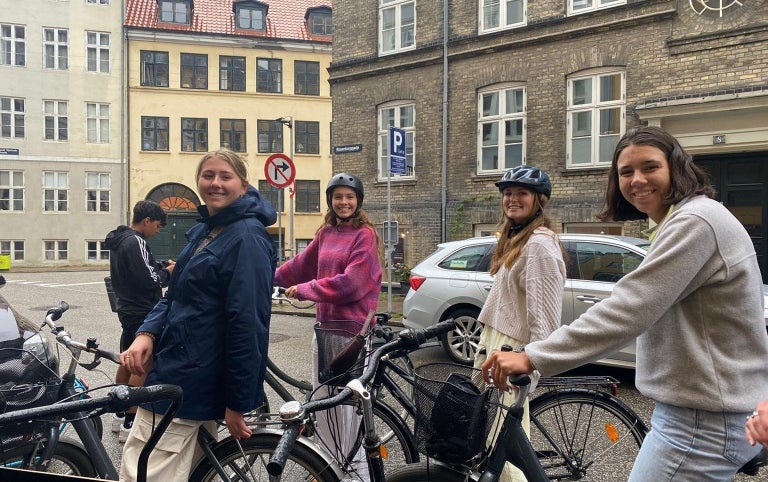
Experience the unique cultural concept of “hygge” in the city that ranks No. 2 in the world for quality of life. In Copenhagen, immerse yourself in Danish culture while navigating modern urban design in a city that dates back to the 11th century. Take the World by the Horns takes you outside the classroom and into research centers, clinics and public spaces to experience the systems that foster wellness firsthand.
You will enroll in four courses offered by our partner, DIS Copenhagen, that focus on broader aspects of Danish life, including Danish language and culture. DIS courses combine traditional classroom instruction with engaging visits to local sites. You will also travel outside of Denmark to experience and compare U.S. and Danish healthcare to other international systems.
There is no language requirement for participation. A Scandinavian language and culture course will be incorporated throughout the semester and will appear on your transcript. Upon your return, you may take a placement test or seek an evaluation to assess your UT Austin language course level.
Academics
The Take the World by the Horns Copenhagen courses are integrated into the degree plans for students in the College of Liberal Arts, the College of Education, the Moody School of Communication, the School of Information, the School of Nursing, the School of Civic Leadership, the LBJ School of Public Affairs, and the School of Social Work. Limited spots are available for the College of Natural Sciences, the College of Fine Arts, the Jackson School of Geosciences, and the Cockrell School of Engineering. McCombs School of Business, School of Architecture, Computer Science, and Statistics and Data Science majors are not eligible for this program.
The academic theme course and language and culture course are required. Students must select two other courses from the available options after attending summer orientation.
| Course Title | UT Course Number | Core Credit |
|---|---|---|
| Healthcare Systems: A Comparative Approach (Required) | H S 329S | |
| Danish Language and Culture (Required) | GSD 319S | |
| The Good Life | PHL 329s | |
| Environmental Impact of Humans | GRG 306C | Social Behavioral Sciences |
Differential and Integral Calculus | M 408C | |
Foundations of Data Analysis | SDS 302F | |
| *Principles of Chemistry I | CH 301 | Natural Science and Technology, Part I |
| *Health professions schools in Texas have undergraduate coursework requirements for admission that must be taken in-residence at a U.S. accredited institution. Students seeking to attend health professions schools upon graduation should be aware that courses offered on this program are not considered “in-residence.” Please consider future academic planning before participating, as this may delay completion of requirements beyond the standard timeline. You can read more about these requirements and guidance from the University of Texas at Austin Health Professions Office. | ||
- Course Details
The learning experience in this program will introduce students to Danish culture in order to understand how Danes view wellness and how it influences their healthcare system. Students will then compare this approach to the healthcare system of neighboring Scandinavian countries Sweden and Norway.
- “Healthcare Systems: A Comparative Approach” examines how various healthcare systems are organized and financed in Denmark and Northern Europe. The course includes visits to healthcare sites in Sweden and Norway.
- “Environmental Impacts of Humans” focuses on the effects of the environment on human health within the paradigms of civilization and ideologies.
- “The Good Life” explores European philosophical perspectives of what it means to live the fullest and richest life, delivering insights that students can use to inform their understanding of healthcare and well-being.
- “Danish Language and Culture” will emphasize the cultural components of life in Denmark to give students tools to better understand and communicate with the Danish peers and colleagues they meet.
- “Principles of Chemistry I” will provide a foundational understanding of chemistry concepts, including gases, electronic structure and periodic trends, classical bonding, VSEPR, Lewis Dot structures, quantum, VB and MO theories, polarity, intermolecular forces, liquids, solids and thermodynamics. Intended for engineering and CNS majors.
- “Differential and Integral Calculus” covers elementary topics in the theory of real-valued functions of a real variable: limits, continuity, derivatives, maxima and minima, integration, area under a curve, volumes of revolution, trigonometric, logarithmic and exponential functions, and techniques of integration.
- “Foundations of Data Analysis” provides an introduction to data analysis and statistical methods. Topics may include: random sampling; principles of observational study and experimental design; data summaries and graphics; and statistical models and inference, including the simple linear regression model and one-way analysis of variance.
- Signature Course Offered
After completing their fall semester abroad, students can enroll in a signature course to continue exploring the academic themes with their cohort.
Professor Aaron Rochlen’s signature course, “Music and Mental Health,” examines mental health disorders through music, investigating music’s effects on psychological and physiological well-being, and using music as a tool for reflection and self-awareness. Through an experiential learning approach that combines lectures, discussions, interactive exercises, and engagement with Austin-based singer-songwriters, students analyze how music reflects and influences human experiences and mental health.
Energy and the Environment
Students can also explore how Copenhagen serves as a global center of sustainability, examining the impact of humans on the environment and how Denmark has invested in renewable energy sources like wind power. Students will also learn more about how the Danish integrate sustainable practices into their everyday lifestyle. The courses offered will vary depending on students’ majors.
You will enroll in four courses offered by our partner, DIS Copenhagen, that focus on broader aspects of Danish life, including Danish language and culture. DIS courses combine traditional classroom instruction with engaging visits to local sites. You will also travel outside of Denmark to visit renewable energy and conservation sites.
There is no language requirement for participation. A Scandinavian language and culture course will be incorporated throughout the semester and will appear on your transcript. Upon your return, you may take a placement test or seek an evaluation to assess your UT Austin language course level.
Academics
The Take the World by the Horns Copenhagen courses are integrated into the degree plans for students in the College of Liberal Arts, the College of Education, the Moody School of Communication, the School of Information, the School of Nursing, the School of Civic Leadership, the LBJ School of Public Affairs, and the School of Social Work. Limited spots are available for the College of Natural Sciences, the College of Fine Arts, the Jackson School of Geosciences, and the Cockrell School of Engineering. McCombs School of Business, School of Architecture, Computer Science, and Statistics and Data Science majors are not eligible for this program.
The academic theme course and language and culture course are required. Students must select two other courses from the available options after attending summer orientation.
| Course Title | UT Course Number | Core Credit |
|---|---|---|
Sustainable Development in Northern Europe (Required) | GRG 329S | |
| Danish Language and Culture (Required) | GSD 319S | |
| Environmental Impact of Humans | GRG 306C | Social Behavioral Sciences |
Urban Ecology | GEO 302G | |
Differential and Integral Calculus | M 408C | |
Foundations of Data Analysis | SDS 302F | |
| *Principles of Chemistry I | CH 301 | Natural Science and Technology, Part I |
| *Health professions schools in Texas have undergraduate coursework requirements for admission that must be taken in-residence at a U.S. accredited institution. Students seeking to attend health professions schools upon graduation should be aware that courses offered on this program are not considered “in-residence.” Please consider future academic planning before participating, as this may delay completion of requirements beyond the standard timeline. You can read more about these requirements and guidance from the University of Texas at Austin Health Professions Office. | ||
- Course Details
The learning experience in this program will introduce students to Danish perspectives on sustainability and climate change. Students will examine approaches to conservation across the European Union and compare environmental approaches in Denmark and Spain.
- “Sustainable Development in Northern Europe” examines sustainability, the climate crisis and environmental degradation through climate justice perspectives. The course includes visits to renewable energy and conservation sites in Denmark and Sevilla, Spain.
- “Environmental Impacts of Humans” focuses on the effects of the environment on human health within the paradigms of civilization and ideologies.
- “Urban Ecology” examines how both nature and humans have responded ecologically and evolutionarily to urbanization. The course will examine physical and biological factors that drive the ecology of urban areas.
- “Danish Language and Culture” will emphasize the cultural components of life in Denmark to give students tools to better understand and communicate with the Danish peers and colleagues they meet.
- “Differential and Integral Calculus” covers elementary topics in the theory of real-valued functions of a real variable: limits, continuity, derivatives, maxima and minima, integration, area under a curve, volumes of revolution, trigonometric, logarithmic and exponential functions, and techniques of integration.
- “Foundations of Data Analysis” provides an introduction to data analysis and statistical methods. Topics may include: random sampling; principles of observational study and experimental design; data summaries and graphics; and statistical models and inference, including the simple linear regression model and one-way analysis of variance.
- “Principles of Chemistry I” will provide a foundational understanding of chemistry concepts, including gases, electronic structure and periodic trends, classical bonding, VSEPR, Lewis Dot structures, quantum, VB and MO theories, polarity, intermolecular forces, liquids, solids and thermodynamics.
- Signature Course Offered
After completing their fall semester abroad, students can enroll in a signature course to continue exploring the academic themes with their cohort.
Professor Laura Gonzalez’s signature course, “Problem Solving: Social-Ecological Systems,” explores cities as complex social-ecological systems and teaches students how social and environmental factors interact to influence urban ecosystem functions and services. Through hands-on scientific inquiry, students develop critical thinking, research, communication, and collaboration skills by designing and conducting an independent research project with guidance from a team of dedicated instructors.