Teacher Feature: Meghan Ackley, English Language Center Instructor
- Jul 30, 2026
- English Language Center
- by Ellen Stader


[Editor's Note: This story is part of a Texas Global series celebrating the work of faculty members in the English Language Center at The University of Texas at Austin.]
The English Language Center (ELC) at The University of Texas at Austin provides an array of language-learning services for students at all levels of proficiency, with course offerings that can be tailored and customized for groups from a diverse range of backgrounds.
The center’s more than 20 experienced faculty members apply time-tested techniques in lesson planning, student practice and teaching methodology, executing them with a comprehensive set of skills and cutting-edge tools to boost learning for students at all levels. Regular opportunities to join social immersion activities also help students feel more at ease and integrate better culturally, lessening pressure and boosting connection and confidence.
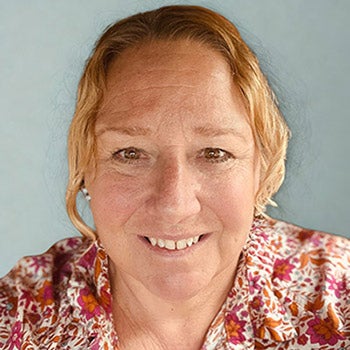
Among the ELC’s outstanding roster of instructors is Meghan Ackley, who teaches classes in listening, speaking, reading, grammar and pronunciation.
Equipped with dual master’s degrees in applied linguistics and Slavic linguistics, plus fluency in four languages and a background teaching abroad in the Czech Republic, she has been teaching at the English Language Center since 2005.
“My biggest hope is always to connect with my students and help spark some kind of transformation — not just in their English, but in their confidence, their understanding of American culture, and their ability to build relationships and community.”
Please describe your educational and professional background.
Working backwards: I’ve been teaching at the ELC at UT since 2004. Before that, I was finishing my master’s in Slavic Linguistics at UT while serving as a teaching assistant in various Slavic language and literature courses.
My previous English teaching experience was at San José State University, where I earned my MA in TESOL in 1998. I taught for three years in the Studies in American Language program, which is very similar to the Intensive English Program we have at Texas Global today. Before that, I taught 1992-1996 at the Pedagogical Faculty of the University of West Bohemia in Plzeň, Czech Republic.
How did you originally become an English as a Second Language (ESL) instructor?
I got into English teaching in the early 1990s after the fall of the Berlin Wall. I had finished my B.A. in French at Santa Clara University, worked for a year in the hotel and hospitality industry, and was looking for an adventure. At 22, I sold all my belongings and bought a one-way ticket to Czechoslovakia, where my alma mater was running a summer program.
The program involved studying Czech in the mornings and teaching small English conversation groups in the afternoons. I was told there would be plenty of teaching opportunities for native English speakers, and luckily, that turned out to be true. I loved it so much that I renewed my contract for three more years.
It was a crash course in teaching — I had no formal experience — but it made me realize I had found my career. I eventually returned to the U.S. to earn my master’s in Teaching English to Speakers of Other Languages (TESOL) so I could continue teaching here.
Please describe your work at the ELC.
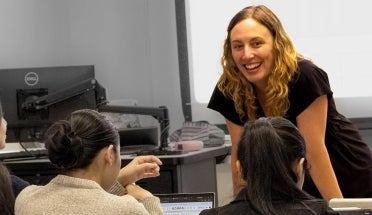
Over my 22 years at the English Language Center, I’ve taught in most of our programs and just about every type of class: grammar, reading, writing, listening and speaking. These days I primarily teach graduate students during the regular academic year.
Our courses help students from a wide range of disciplines navigate the English-speaking, cultural and academic expectations they’ll encounter at UT. I teach two levels of Oral Communication, where students develop presentation, discussion and pronunciation skills while also learning the cultural and academic norms that help them succeed at the University.
What hopes do you have for your work as an instructor at the ELC?
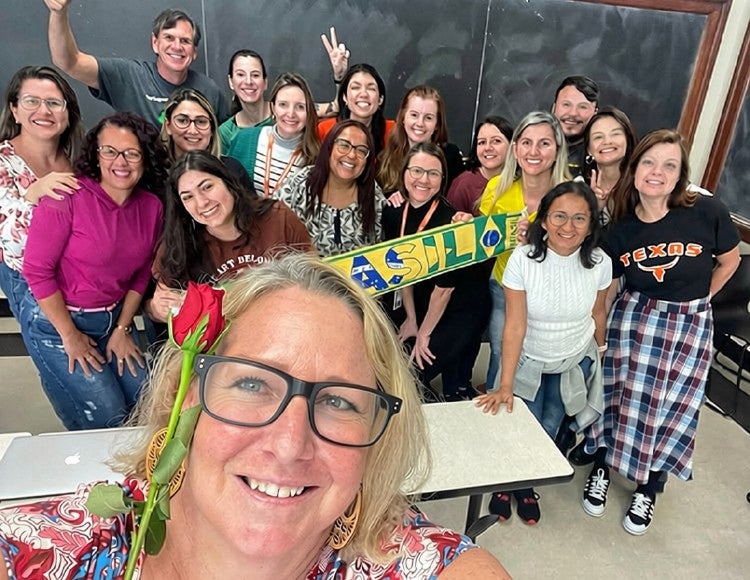
My biggest hope is always to connect with my students and help spark some kind of transformation — not just in their English, but in their confidence, their understanding of American culture, and their ability to build relationships and community.
Many of my students take my class because they didn’t pass the J-Hold exam, but my goal is to make the course far exceed their expectations. No one majors in ESL, so it’s our job to show students the value of the course and help them communicate with one another.
Those conversations often turn the class into something much more than an ESL course. By the end of the semester, it becomes a community where genuine friendships and support systems have formed.
What has teaching English taught you?
So many things! At the top of the list is the importance of understanding my students. Learning about their goals, expectations and needs shapes everything I do and helps me tailor my teaching to the group in front of me.
Ultimately, it’s not just about grammar or language skills. It’s about recognizing where the gaps are in students’ knowledge, confidence or communication, and helping them bridge those gaps.
What do you wish more people understood about learning a language?
Learning a language is different from learning most other subjects because there’s such a significant social component. If students don’t feel comfortable or relaxed, it’s very difficult for them to communicate.
My job is to create a friendly, non-threatening environment where students feel safe to speak, make mistakes, and learn without fear of judgment from me or their classmates. That kind of classroom is what truly facilitates language learning — not simply teaching grammar or vocabulary.
What has motivated you the most over the years?
Having the freedom to create my own courses and adapt them to different groups and situations has kept me motivated throughout my career. I’ve also had the opportunity to teach a number of teacher-training courses.
Working with teachers is especially rewarding because we all share the joys and frustrations of the profession — from teaching multilevel classes to navigating motivation, equity and the daily challenge of creating engaging lessons. Connecting with other teachers and learning from one another has always been incredibly inspiring.
What do you like most about teaching? What do you find most difficult?
Without question, the students are my favorite part of teaching. I genuinely enjoy getting to know the people in my classes. English becomes the medium through which we connect, but I develop a real interest in their lives, their majors and their aspirations. By the end of the semester, I'm always a little sad to say goodbye.
The hardest part for me has always been the bureaucracy and paperwork. I’ve never been someone who enjoys sitting behind a desk doing administrative tasks. I’d much rather be creating lessons, standing in front of the class, moving around the room and interacting with students.
What is your best teaching memory?
One memory that has always stayed with me involves a nursing student from Nicaragua. At the time I was pregnant with my son, and I had a habit of sitting on desks and standing on chairs while teaching. One day she told me I needed to stop because she didn't want her "favorite teacher" to get hurt.
It was the first time a student had called me their favorite teacher — but thankfully not the last. Those words never get old.
When I teach methods courses for future ESL teachers, I tell them they have a choice: They can be the kind of teacher students remember because they embarrassed them or made them feel small, or they can be the kind of teacher students remember because they made them feel seen, heard, and capable of growing. I always advise them to be the second one.