International Wildfire Competition Sparks UT-Founded Tech Firm
- Oct 13, 2026


When a team of aerospace engineering students from The University of Texas at Austin set out to build an unmanned aircraft to detect and extinguish wildfires, they weren’t just working toward a final grade. Their project would grow from the class into an international competition and beyond even the aircraft itself.
The effort began when Professor Luis Sentis approached Greg Zwernemann, a professor of practice, both in the Department of Aerospace Engineering and Engineering Mechanics, about entering the XPRIZE Wildfire Competition, an $11 million competition that incentivizes the innovation of firefighting technologies to transform wildfire management. Zwernemann’s senior design course took on the challenge for the 2024-2025 academic year with the goal of creating an unmanned aircraft to locate and quell wildfires.
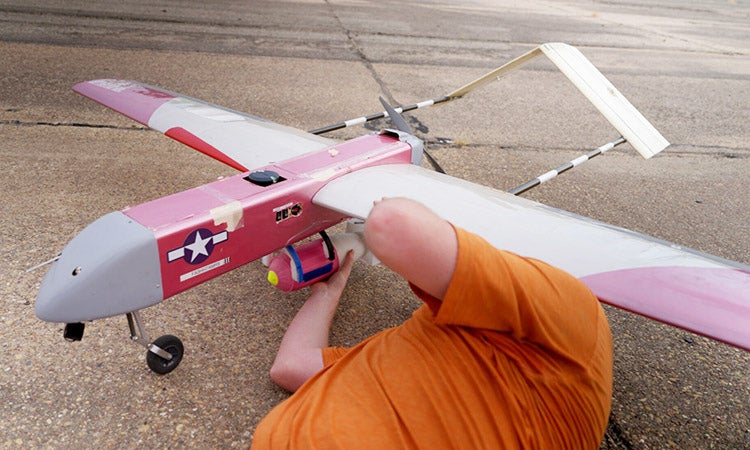
The UT-led “FLARE-X” team became a collaboration between UT’s Jackson School of Geosciences and Cockrell School of Engineering, in addition to the University of Southampton in England, University of Edinburgh in Scotland, the Delft University of Technology in the Netherlands and Texas A&M Forest Service. Competing against 100+ teams from more than 20 countries, FLARE-X advanced to the semifinal round to demonstrate its aircraft at the RELLIS Proving Grounds near Bryan, Texas, in October 2025.
Only five teams moved to the finals, and although UT wasn’t one of them, the competition pushed the FLARE-X endeavor from a classroom project into its own enterprise. One of the initial requirements of the competition was for each team to establish its own company. The student team created and worked under the newly founded AIVE AI Systems Inc., and by the time UT exited the competition, the company had taken on a life of its own.
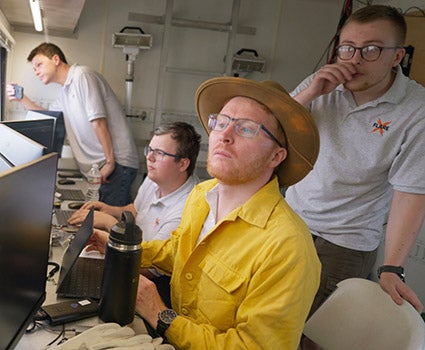
Sentis spearheaded efforts to establish and expand AIVE beyond XPRIZE and the University. Development efforts carried through the summer and fall of 2025, employing dozens of undergraduate and graduate students and drawing continued support from UT’s Discovery to Impact, which helped finance necessary resources and supported AIVE’s spinoff as an independent company.
After graduation, aerospace engineering students Romain Roussel (B.S. ’25) and Andrew Doty (B.S. ’25) continued working with AIVE through its focused transition. Doty moved into the commercial side of the business while Roussel, now pursuing a master’s degree, returned to AIVE in summer 2026 as a systems engineering intern.
Rather than continuing to focus on aircraft for wildfires, the team redirected its mission toward a piece of technology developed as a backup system during the competition: software that lets drones determine their location without relying on GPS.
Although the company is navigating a new venture, its ties to UT haven’t loosened. During the 2025-2026 academic year, a new cohort of students designed a second generation of aircraft. The group plans to fund a third generation of student-built aircraft for the 2026-27 academic year, focused on surveillance and mapping missions built around the software the company developed.
The company, born in a UT classroom, built with UT funding and at the hands of UT students, continues to reinvest in the very course that created it.
“They’re getting better every time,” Zwernemann said.