Inaugural Korea Week Marks 30 Years of Partnership
- Nov 10, 2026
- Global Alumni Relations
- by Alex Briseño


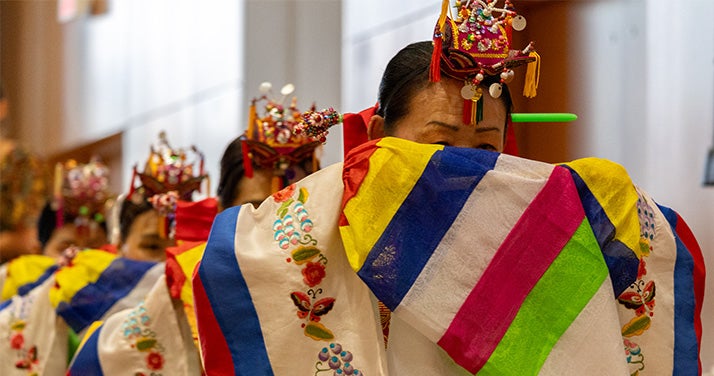
More than 200 people gathered at The University of Texas at Austin to celebrate Chuseok, Korea’s traditional harvest festival, where they enjoyed Korean cuisine and a traditional dance and drumming performance by UriKarak. The event marked the conclusion of the University’s inaugural Korea Week, Sept. 21-25, co-hosted on campus by the Korea Foundation.
The weeklong program showcased the breadth of UT Austin’s nearly 30-year relationship with partners in the country, featuring live performances, film screenings, panels on education abroad and discussions about career opportunities in both countries.
“This vibrant celebration is the result of the University’s long-term investment in building strong and enduring relationships in Korea,” said Sonia Feigenbaum, senior vice provost for global engagement and chief international officer. “Throughout the week, we have enjoyed highlighting our partnerships while experiencing and appreciating the country’s creativity, scholarship, innovation and growing cultural and technological influence.”
Feigenbaum added, “I would like to express my sincere gratitude to the Korea Foundation for its partnership, its support in making this event possible, and its pivotal role in strengthening international understanding and advancing Korean relations worldwide.”
"Korea Week is not an endpoint, but a starting point for building a broader Korea-related community in Austin and, eventually, across Texas and the U.S."
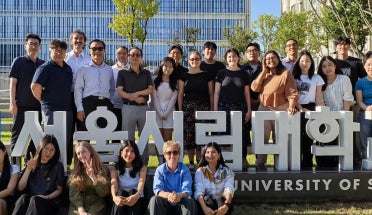
The weeklong event built on momentum generated during the two-day UT Austin Alumni Summit: Innovation Across Borders, which was held in Seoul, South Korea, in April. Organized by Texas Global, the summit attracted more than 120 alumni, industry leaders and academic partners from 15 countries.
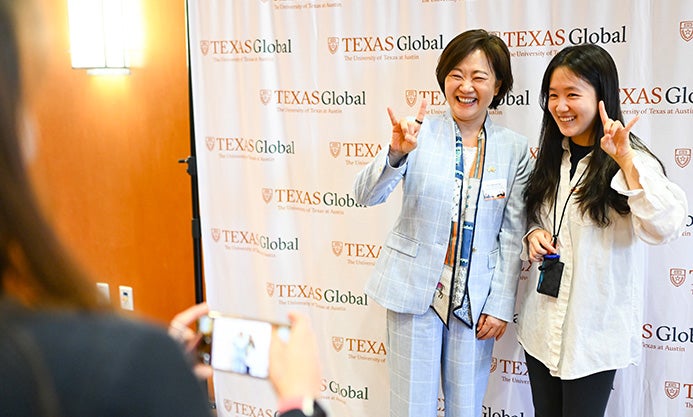
The week of festivities also coalesced two years after the 2024 Korea Studies Forum, the first event Texas Global and the foundation co-hosted on the Forty Acres.
Reflecting on the partnership’s growth through the 2020s, Suyon Lee, Director of Korea Foundation USA, shared some thoughts on the collaboration and development of Korea Week.
“When we began preparing the 2024 Korea Studies Forum, we wanted to develop a university hub in the U.S. South, where Korean companies have been making significant investments, and foster connections among universities, businesses and local communities,” Lee said. “Korea Week grew naturally from those connections, creating a platform for more UT Austin students and the broader Austin community to engage with different aspects of Korea.”
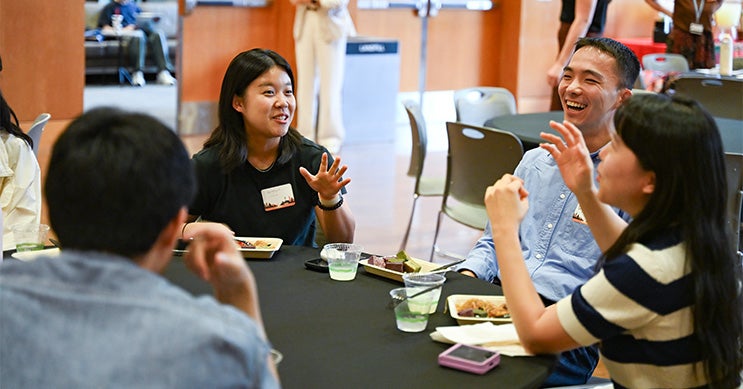
Building Korean Studies on the Forty Acres
Lee emphasized the value UT Austin brings to the partnership, pointing to the University’s longstanding commitment to its Korean Studies program and work to strengthen community connections in Austin.
“In fact, our partnership dates back to 1995, when the Korea Foundation first began supporting Korean Studies at UT Austin,” Lee said. “Since then, the Korea Foundation and UT Austin have continued to collaborate and expand upon this partnership.”
Foundation support arrived shortly after UT Austin created a Korean Language Program within the Department of Asian Studies. As the University expanded its language course offerings throughout the ’90s, the foundation worked with the UT to secure a major donation from POSCO, a global steel manufacturer based in Pohang, South Korea.
The generous gift established the Korea Foundation/ POSCO Korean Studies Endowment, which continues to fund postdoctoral fellowships, distinguished visiting specialists, graduate student fellowships, colloquia, conferences, faculty research and publication development more than 30 years later.
“A condition of the endowment vesting was that UT make a tenure-track hire,” said Professor Rob Oppenheim, the Asian Studies department chair. “In 2003, UT conducted a search, and that’s how I ended up getting hired as the first tenure-track Korean Studies assistant professor at UT.”
Korea Program Deepens Connections
The POSCO gift also helped establish the Korea Program. Serving undergraduate, master’s and doctoral students, the program offers courses exploring the country's language, history, culture, religion and literature. The curriculum also examines contemporary issues facing the country, including economic, ecological, security and ethnic conflicts.
As Oppenheim helped build the program, he observed campus interest growing throughout the 2000s.
“Even back then, I felt like the breadth of interest in Korean Studies was [already] broader here at UT than what I had been used to,” Oppenheim said. “When I took Korean as a graduate student [at the University of Chicago], there weren’t many non-Korean students. But, when I came here to teach, already our Korean language classes were split 50-50 between Korean American students and non-heritage students.”
Oppenheim noted that the “Korean Wave” can be traced to different moments around the world. At UT Austin, he said, a clear shift had arrived by 2010.
“We had early exchange relationships in the 2000s, but more students wanted to come here from Korea than UT students wanted to go there,” Oppenheim said. “We’re always seeking balance in these types of relationships. Luckily, this is a non-issue now.”
Today, campus interest extends far beyond the Korea Program and Center for East Asian Studies.
“We now have a huge number of UT students who arrive with an interest in Korea,” Oppenheim said. “There are lots of students who are now wanting to go to Korea, and they have plenty of study abroad frameworks to choose from.”
Oppenheim moderated a Community Voices panel during Korea Week, which featured representatives from Korean and Korean American organizations on campus and across the greater Austin area. Panelists discussed how their organizations preserve cultural heritage, build community and strengthen local ties, from the Austin Korean School and Korean American student associations to the Austin-Gwangmyeong Sister Cities Committee and Korean American Association of Greater Austin.
Take the World by the Horns in Seoul
For the Korea Foundation delegation, one of the week’s most memorable moments came during the Take the World by the Horns student panel, facilitated by Laura Caloudas, assistant director of Education Abroad.
Launched in Fall 2024, Take the World by the Horns is a competitive program that offers first-year students the opportunity to begin their college career with a semester abroad in one of five cities: Athens, Greece; Copenhagen, Denmark; Panama City, Panama; Seoul, South Korea; or Stockholm, Sweden.
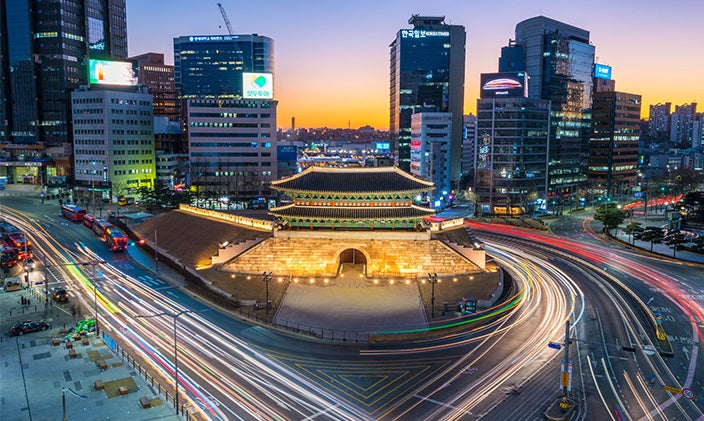
“What resonated with us most was the student panel. Studying abroad is not only about learning about another country, but also about discovering another side of yourself,” said Juheui Jung, assistant director at the Korea Foundation, who attended the student panel. “Those experiences can stay with students long after they return home. Whether they studied at a university in Korea, lived in a local community, or taught English and interacted with Korean children, those personal experiences create a lasting connection.”
Over the past decade, more than 1,000 Longhorns have studied in Korea, and more than 3,000 UT alumni live there now, making it one of the University’s largest global alumni communities. Korea is also UT Austin’s third-largest source of international students and scholars, and more than 75 faculty members engage in Korea-related research and creative work.
“Over time, these individual experiences can become a network [built by] alumni who continue to connect with one another and with institutions in Korea,” Jung said. “We think there is an opportunity to make that network even stronger by creating more opportunities for alumni, current students, Korean institutions and the Korean community in Texas to stay connected.”
Lasting Partnerships in Industry and Culture
The relationship between UT Austin and Korea also reaches into Central Texas’ growing semiconductor industry. David Gentry, vice president of people at Samsung Austin Semiconductor, recounted the company’s partnership with the University and three decades in the region.
“Over the course of time, we’ve had thousands of UT graduates from around the world who come to work at Samsung,” Gentry said. “The University of Texas at Austin has been a tremendous longtime partner for Samsung.”
Samsung Austin Semiconductor offers one example of Korea’s deep investment in Central Texas. The company established its first U.S. manufacturing site in Austin in 1996 and has since expanded its Central Texas operations to Taylor, strengthening the region’s role in the global semiconductor industry.
Korea’s global influence reaches beyond business and industry to span a range of aspects, including prominent contributions in popular culture. That breadth shaped how the Korea Foundation and Texas Global approached Korea Week programming.
“With Korea Week, we wanted to go beyond the aspects that people may already be familiar with — BTS, ‘Parasite’ and ‘KPop Demon Hunters’ — and show how Korea has evolved and developed across a wide range of fields,” Lee said. “Through the experiences of students who studied in Korea, as well as perspectives from Korean companies and programs on education, technology, culture and history, we wanted students to see the diverse and dynamic aspects of contemporary Korea.”
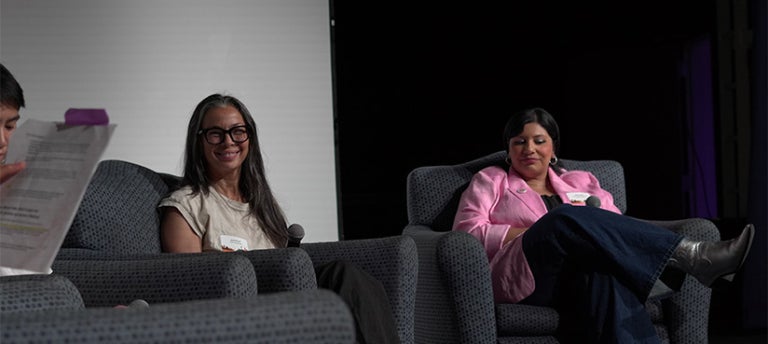
On Sept. 22, the Asian American Film Festival supported the screening of Before the Call (2025), an independent film directed by Korean American James Choi. Judi Krant, a producer of the film, joined Neha Aziz, artistic director of the Austin Asian American Film Festival, for a post-screening discussion moderated by Assistant Professor of Instruction Alice McCoy-Bae.The coming-of-age drama centers a Korean American man who voluntarily enlists in the Korean military and spends the days before deployment questioning his identity, his family ties and the meaning of the war he has chosen to join.
Continuing to Build Together
Korea Week offered an opportunity to celebrate and build on the nearly 30-year partnership between UT Austin and the Korea Foundation. For Lee, sustaining that momentum means creating connections that extend beyond the successes of the alumni summit and Korea Week in 2026.
“Looking ahead, our goal is to make this partnership sustainable beyond individual events,” Lee said. “We hope UT Austin can continue to serve as a hub where students, researchers, companies, and the local community can connect with Korea.”
The foundation and Texas Global share mutual excitement as leadership explores additional academic, cultural and industry partnerships that will grow from Korea Week connections.
“The 2024 Korea Studies Forum helped bring together partners from academia, industry and the community, and Korea Week has given us an opportunity to bring many of those connections into one platform,” Lee said. “What we hope to see next is that the relationships formed through Korea Week will lead to new research collaborations, student programs, community initiatives and other projects. In that sense, Korea Week is not an endpoint, but a starting point for building a broader Korea-related community in Austin and, eventually, across Texas and the U.S."