Building Cities for Better Weather
- Nov 19, 2026
- Global Initiatives
- by Alex Briseño


[Editor's Note: This feature is part of a Texas Global story series celebrating International Education Week 2026.]
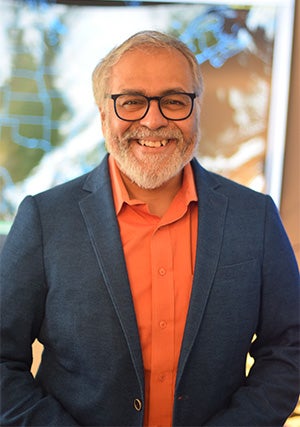
Professor Dev Niyogi has spent much of his career studying the relationship between people and weather: how atmospheric conditions shape day-to-day life and how human decisions can, in turn, influence the environment and how people experience it.
That dynamic has intrigued Niyogi since his childhood in a growing suburb of New Mumbai. He still remembers his excitement and anticipation leading up to June 7 each year. The date marked the first day of school and almost always coincided with the first monsoon rains of the season, making the time stamp practically impossible to forget.
He recalls the new school uniforms, the textbooks he carried to and from campus, and the new shoes that would get him there. He also remembers the daily question: “Can we beat the monsoon, or is the rain going to affect us?”
“It was an exciting time,” he said.
What stands out most vividly in Niyogi’s mind are the days he forgot to bring an umbrella or raincoat. At times, he had to dry his books under a fan after a wet commute, when paper and plastic bags didn’t stand a chance as a protective layer against the storms.
“I saw my friends who had an umbrella or a raincoat, and I noticed that they were clearly not bothered the way I was,” Niyogi said. “It told me that a simple action by an individual can completely alter the impact of weather or a hazard.”
It was a small but formative observation, one that would eventually take on greater significance in Niyogi’s work at the Jackson School of Geosciences. Niyogi holds the William Stamps Farish Chair in the Department of Earth and Planetary Sciences at the Jackson School. He also serves as a UNESCO Chair and is affiliated with professor in the Department of Civil, Architectural and Environmental Engineering at the Cockrell School of Engineering, and LBJ School for Public Affairs and leads research through the Texas Extreme Weather and Urban Sustainability Lab, or TE(x)US.
Long before he began studying how cities, landscapes and human activity influence the atmosphere, he recognized how individual decisions could change the way people experienced the same weather event.
“Growing up in a growing part of coastal city like Mumbai, you almost always have nature around you. That might seem a bit paradoxical because most people think of Mumbai as a city,” Niyogi said. “To be able to navigate the city, you need to be constantly aware of the weather in the context of what it might do to your commute, what it might do to your experience, or what you're planning to build.”
Those experiences prompted him to ask: ‘What if things don’t have to be the way they are?’ and ‘What if we could change the weather?’
Climate and shifting atmospheric patterns have altered monsoon seasons worldwide in the intervening decades, but those June storms remain among Niyogi’s enduring memories. They have shaped his work and worldview ever since.
Career by Serendipity
The small-town schoolboy grew up to study engineering in India, driven by his interest in mathematics and abstract concepts. Even after he was admitted to college, however, he faced pressure to pursue computational sciences that would have likely grounded him in an Information Technology industry.
“But I was determined to study environment, and so that was it,” Niyogi said. “I think I just had perhaps spiritual, personal or some type of guidance to move in a different direction, and so I did.”
His eventual move into atmospheric sciences came through an unexpected encounter. While completing his undergraduate studies, Niyogi met a visiting researcher from Oak Ridge National Laboratory in Tennessee who took an interest in his work on air pollutants and clouds and encouraged him to consider a career in the field.
“I'd not thought about atmospheric science at that point,” Niyogi said. “And so that was a chance meeting with somebody who just comes in and tells you, ‘This might be what you’re looking for.’ That’s what led me to consider it.”
With help from his technical advisor, Niyogi contacted a researcher at North Carolina State University. The researcher already had a trip planned to India for a research project, and the two arranged a meeting. The exchange led to a meeting, a research opportunity and eventually Niyogi's move to North Carolina State. There, he earned two atmospheric science degrees, a master's degree in 1996 and a Ph.D. in 2000. Afterward, he spent more than 15 years at Purdue University, where he also served as Indiana’s state climatologist.
Understanding Austin’s Rapid Growth

When Niyogi first visited Austin in 1994, he encountered a city that would look considerably different by the time he stepped onto the Forty Acres in 2020. He had spent much of his career studying how agricultural landscapes influence weather and climate, but his research was increasingly shifting toward urban environments, storms and severe weather.
UT's reputation, resources and opportunities, along with Austin's rapid growth and the environmental challenges accompanying it, made the University an appealing next step.
“Coming to Austin, where we have a burgeoning economy and the city’s rapid growth, you have the challenges associated with extreme weather,” Niyogi said. “Those were all the factors that made place-based sense.”
Now at UT Austin, as the principal investigator of the TE(x)US Lab, he studies extreme weather and cities with tools like digital twins. He also co-leads the UT-City CoLab, an applied research and civic partnership between UT Austin and the City of Austin focused on addressing climate and its impact on urban areas and improving the quality of life for the communities and hands-on experiences for the students.
“It is important that the work you do is grounded in some local priorities, because it gives you the ability to find some intuitive or serendipitous partnerships,” Niyogi said. “There is more synergy in working with other people who might be doing similar work and creating new science or impact. Those are all reasons for me coming to Austin.”
Today, he sees Austin poised at a consequential moment as the University's research enterprise, technological innovation and artificial intelligence intersects with the city's explosive growth. He expects people will look back 10 or 15 years from now and recognize how significantly those forces shaped the region.
“We are in exciting times,” he said. “Often times, the daily humdrum might not allow us to take that 30,000-feet view on the place and time we are in, in terms of witnessing and imagining what we are going through right now.”
One certainty for Niyogi is that when he tries to answer this question in the future, he will recall how fantastically Austin was growing in this moment, and how the city, UT leadership and researchers used the technology boom as a means to build a smart, vibrant, affordable and sustainable environment.
“We will look at this time as the search for the most optimized path to build the best possible ecosystem that can sustain and nurture intellectual curiosity, the ability to grow things, the ability to scale things and have an impact not just locally but globally,” he said.
Achieving Preferable Weather
With the city’s rapid growth comes responsibility. Niyogi believes that one challenge is ensuring that the growth and intellectual resources of Austin and UT will translate into a stronger, more livable city, region and state.
“How we handle some of our local issues — extreme heat, mobility, homelessness and affordability — is going to feed into the kind of experience our students, our faculty, our visitors, will have in this region,” he said. “It will shape our reputation. It will include tussle and tension, naturally, because these are not easy issues.”
Niyogi added, “I think great universities are in great places. When you have this fusion of the town-gown interaction, working to help each other, magic happens.”

Niyogi’s research aims to improve the prediction of severe weather by understanding how land affects the atmosphere. He applies that knowledge to help plan and design future cities.
“With something like urban expansion, we know that the weather changes,” Niyogi said. “My work has been this: How do you understand what is going to be the effect of such changes? How can you predict them? How can you use this knowledge — of how cities or land can change the weather and risks such as heat stress and floods— in a way that can help us plan for future cities?”
As researchers understand how a city or landscape affects the atmosphere, Niyogi said, the job becomes to help guide urban growth to “achieve the type of weather we want.”
Global Networks Offer Advantages
For Niyogi, one of the most fascinating aspects of weather is that it has no boundaries. With the upcoming El Niño, for example, researchers may look at conditions in Brazil to anticipate weather impacts on corn and soybean in Iowa. Russian heat waves and Indonesian wildfires can also help researchers understand and prepare for extreme weather events closer to home.
“To us, the globe is a petri dish, and we need to have these working connections with each and every corner of the world,” Niyogi said. “That’s what we will be continuing to do in building this up as one world.”
That perspective has shaped much of Niyogi’s work throughout his career. He has collaborated with researchers and institutions across India, South Korea, Japan, Saudi Arabia, France, Singapore and Australia, as well as other countries throughout Europe, South America and Africa.
“These partnerships that we develop with other countries, with other institutions, with other researchers, they all tell us the same story: that deep down, driven by curiosity, we are all working towards solving the same problems of building a better future,” Niyogi said.
Niyogi’s approach was on display during the 2024 Paris Olympics Research Demonstration Project, when he led a UT research team that used artificial intelligence to produce daily weather forecasts during the Olympics. In addition to forecasts for temperature, wind and precipitation, the team developed estimates of “thermal comfort,” accounting for the way surrounding buildings and trees could influence how hot conditions felt on the ground. The work was part of an initiative supported by the World Meteorological Organization that brought together research teams and national weather services from several countries.

“It was a brilliant experience with this hodgepodge team of students, researchers and enthusiasts working with research teams from other countries,” Niyogi said. “We are actually going to be involved with similar efforts related to the Los Angeles Games in 2028 and using that knowledge to build the tools we can use for tree planting and shade planning in Austin, which is an example of how global partnerships are helping us back home.”
For Niyogi, maintaining transnational relationships is both a practical investment in the University's future and an extension of its broader mission. As the world becomes increasingly interconnected, he believes institutions that establish strong international partnerships now will be better positioned to exchange ideas, advance research and contribute to solving global challenges in the future.
“I strongly feel that we need to establish and continue building our strong international footprint,” Niyogi said. “Because those who have global networks in place now will be the ones who have the most influence and benefit from those partnerships in near future.”
'Global Collaboration is Part of Our Spirit’
Decades after Mumbai’s monsoons first sparked his curiosity about human decisions and weather, Niyogi is still pursuing the same questions, though now on a much larger scale.
In his roles both on campus and globally, Niyogi continues to explore a question that has followed him from Mumbai to Austin: How can a better understanding of weather, technology and cities help communities prepare for what comes next and prosper?
For Niyogi, answering that question requires looking beyond any single city or country, and instead relying on the global relationships that have shaped and sustained his career.
“This is precisely the time when UT, with all its capabilities, needs to position itself globally, such that we are the players the world looks to,” Niyogi said. “What starts here changes the world — global collaboration is part of our spirit, and it’s what we are.”