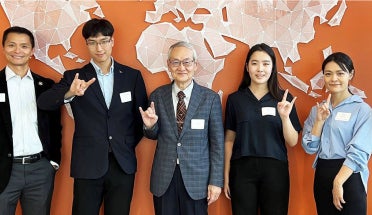
Fulbright Visiting Scholars Power Partnerships with Brazil, Hungary, Mexico
- Apr 16, 2026
- Global Initiatives
- by Ellen Stader, Alex Briseño and Riddhi Bora


The Fulbright Visiting Scholar Program at The University of Texas at Austin brings international scholars, professionals and performers to lecture and conduct research at colleges and universities across the United States. UT is proud to host Fulbright Scholars annually as visiting faculty members working across academic disciplines.
During the 2025-2026 academic year, three professors from universities in Brazil, Hungary and Mexico came to UT Austin for a semester to serve as visiting faculty, representing the fields of chemical engineering, archaeology and law.
This marks the inaugural year for the Fulbright Hungary and Fulbright Brazil visiting professorships. All three partnerships serve as a testament to the Fulbright program’s resilience and integrity in a time of emerging and substantial obstacles, as well as UT’s ongoing commitment to advancing global engagement.
Texas Global welcomed these scholars to the Forty Acres and integrated them into the vibrant academic community during the 2025-2026 academic year.
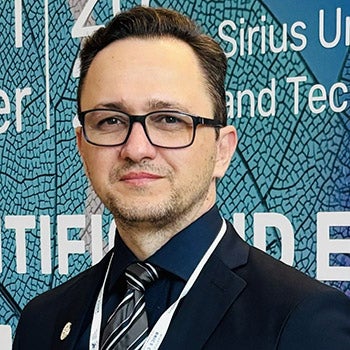
Marcos Leite
Associate Professor, Institute of Chemistry,
Universidade Federal do Rio Grande do Sul, Brazil
“Accelerating Material Discovery: Integrating Machine Learning with Robotic Platforms for Controlled and High-Throughput Synthesis of Semiconductor Nanomaterials”
Marcos Leite, associate professor at the Universidade Federal do Rio Grande do Sul, regards serving as a Fulbright Brazil Distinguished Chair at UT Austin as a defining moment in an internationally engaged academic career shaped by perseverance, collaboration and applied science.
Leite earned his bachelor’s, master’s and doctoral training in chemistry in Brazil, with a formative period of doctoral study at the University of Victoria in Canada. Since becoming a professor in 2010, he has built an extensive network of international collaborations, conducting research at institutions in Canada, Switzerland and Belgium before arriving in Austin as a visiting professor in the Cockrell School's McKetta Department of Chemical Engineering.
“The visiting professor is a much deeper experience. It's much more rewarding, for sure, but it demands much more,” he said. “I am [teaching as] a professor at one of the best universities in the world, so that's a big thing for me.”
At UT, Leite is collaborating with Professor Brian Korgel in his research group focused on accelerating materials discovery for renewable energy applications by integrating machine learning, artificial intelligence and robotic platforms into laboratory workflows. In addition, Leite teaches a graduate-level course on nanoparticle synthesis.
Teaching at UT has influenced Leite's pedagogical approach. While his courses are mathematically intensive, Leite emphasizes connecting theory to laboratory practice and engaging students through dialogue.
“I have been improving my lectures, as well. When I go back to Brazil, my lectures will be better,” he said. “I try to give the students all the fundamentals they need — all the thermodynamics, all the kinetics — related to what they are learning, all those equations and what they mean when they go to the laboratory.”
Leite views his Fulbright experience as a foundation for long-term collaboration and institutional exchange. He hopes the partnership with UT will enable ongoing student exchanges, joint research and sustained collaboration between Brazil and the United States. He reflected on his Forty Acres visit in context of the broader Fulbright mission.
“It demands people who truly believe how important [it] is for people from different countries to interact for advancing science,” he said. “Just people trying to survive and trust people [working] to improve their lives and their families in society.”
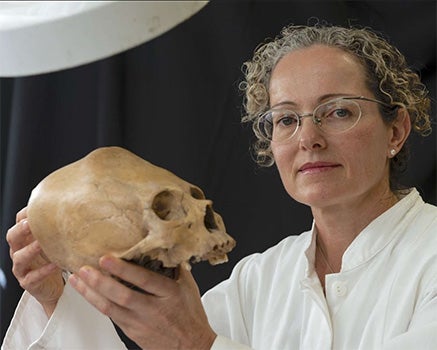
Vera Tiesler
School of Anthropological Sciences,
Universidad Autónoma de Yucatán, Mexico
“Human Remains in Mexican Anthropology: Profiling Ancient Lives and Modern Clandestine Graves”
"My visit to UT has been an enormously gratifying and stimulating experience. Texas Global has been a wonderful host and true to UT’s motto: What starts here changes the world,” said Vera Tiesler, an internationally renowned Mexican bioarchaeologist from an anthropological, archaeological and medical academic background.
Tiesler, a Fulbright-García Robles Visiting Chair, is working this semester with the UT College of Liberal Arts' Department of Anthropology, LLILAS Maya Studies Initiative, and the Mesoamerica Center.
Since 2000, Tiesler has served as a research professor at the Universidad Autónoma de Yucatán, overseeing the Laboratory of Bioarchaeology located in the heart of the Mexican part of the Maya area, including active fieldwork at Palenque, Calakmul and Chichén Itzá.
Tiesler’s interests lie in illuminating the human condition of the ancient Maya and Mesoamericans by studying their mortuary remains. She profiles human skeletal data within the context of Mesoamerican archaeology and forensics to reconstruct living conditions, body modifications and physical appearance — life and death of the ancient Maya. Her current research grant from the Consejo Nacional de Ciencia y Tecnología (CONACYT) focuses on Maya sensorial experiences.
“This semester, I feel delighted and privileged to be part of the vibrant academic crowd of the Anthropology Department of UT, where I’m teaching about Mesoamerican body concepts to UT’s grads and undergrads,” said Tiesler. “I’ve enjoyed finding bibliographic treasures at the Benson Library and sharing productive talks with UT’s community about studying and dignifying human remains in Mexico and beyond.”
She also delivered a lecture for the Lozano Long Institute of Latin American Studies, highlighting Mexican research into archaeologically retrieved skeletal remains and its evolution from uncoordinated research efforts to firm establishment in classrooms, curation facilities and forensic institutions. In Tiesler’s view, skeletal examinations have become increasingly socially relevant given the enforced disappearances and mass unmarked burials now commonly enacted by organized crime in modern Mexico.
A member of the Mexican Academy of Sciences since 2005, Tiesler has authored more than 200 articles and book chapters. Among the two dozen books she’s written and edited are “The Routledge Handbook of Mesoamerican Bioarchaeology” (ed.) and “Ancient Maya Teeth” (UT Press).
Tiesler’s research examines skeletal information together with other material and Indigenous discursive media to understand ancient living conditions and lifestyles, physical appearance and embodied identities, violence and ancestor veneration. She has further engaged with the UT academic community on topics ranging from ancient aristocracies to mercury poisoning, from climate crises to the mortuary records of abandoned cities, from Maya teeth to forensic research conducted on both sides of the U.S.-Mexican border.
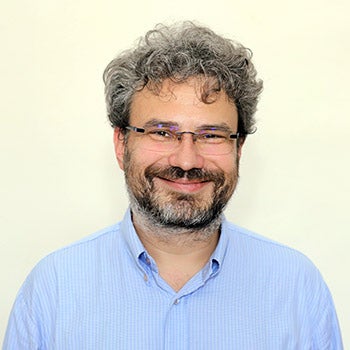
János Fazekas
Associate Professor, Department of Administrative Law,
Eötvös Loránd University,
Faculty of Law, Hungary
“Constitutional and Administrative Justice in Europe, with Special Regard to Hungary”
For János Fazekas, associate professor at Eötvös Loránd University in Budapest, Hungary, the experience as a Fulbright Visiting Scholar with the UT School of Law was both an academic milestone and a personal challenge.
A scholar of administrative and constitutional law, Fazekas focuses on the “political question doctrine” — a legal framework that helps courts determine when a dispute is legal in nature and when it is purely political. Though the doctrine originated in the United States, it has increasingly shaped constitutional debates in Europe, making UT an ideal setting for his research.
Co-teaching comparative constitutional design alongside UT faculty, Dr. Fazekas found particular inspiration in the interdisciplinary culture of the law school and the broader university. Unlike the more departmentally structured academic systems common in Central Europe, UT’s collaborative environment encouraged engagement across fields — from law to political science to international relations.
“It was a surprise for me — a very good surprise,” he said. “Here, the boundaries between disciplines are much more flexible. For my research, which sits at the intersection of law and politics, this was exactly what I needed.”
Beyond the classroom and conference rooms, his time in Austin offered meaningful cultural contrasts. As a scholar who studies the institutional balance between law and politics, he observed the American legal and political environment with thoughtful curiosity — from debates about judicial neutrality to differences in firearm regulation. Yet what stood out most was the openness of the academic community.
“I had anticipated a more closed environment,” he admitted. “Instead, I found colleagues who were incredibly well-informed about Hungary and Europe, and very generous with their time and ideas.”
As he prepared to return to Budapest, where classes resumed almost immediately, Fazekas carried back more than a freshly completed manuscript. He also returned with renewed appreciation for academic flexibility, interdisciplinary dialogue and the importance of stepping outside one’s professional and cultural comfort zone.
“In academia, you need moments to step back. To look at the bigger picture. To get out of your box,” he reflected. “This has been a real sabbatical. I’ve had the luxury to focus on research, to read, to attend workshops, and to talk deeply with colleagues.”
UT Austin is proud to host visiting Fulbright Scholars across academic disciplines each year. To learn more about UT’s Visiting Chair residencies, visit the Fulbright Visiting Scholar Program page on the Texas Global website.