Science to Startups: Professor Brian Korgel’s International Vision
- Mar 31, 2026
- Education Abroad
- by Ellen Stader


Professor Brian Korgel is everywhere — in some senses, quite literally: His 28-year career at The University of Texas at Austin features an uncommonly robust record of global engagement.
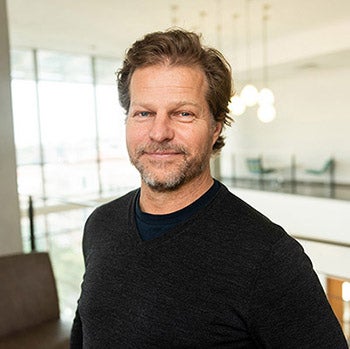
Spanning continents and disciplines, Korgel has studied, lectured, collaborated on research, hosted visiting scholars and led study abroad trips in connection with nearly 20 countries, including Australia, Brazil, Canada, Denmark, France, Ireland, Italy, Japan, Korea, Mexico, New Zealand, Portugal, Spain, Sweden, Switzerland, Taiwan, and the United Kingdom.
As a professor in the McKetta Department of Chemical Engineering at UT’s Cockrell School of Engineering, Korgel focuses on fundamental research in nanotechnology, developing methods for synthesizing nanostructured materials, studying their properties and fabricating related devices.
He breaks down these concepts more simply as “making materials that haven't been made before; or taking a material someone's discovered [and learning] how to make and improve it; or thinking about what that material might be used for.”
Korgel's research sits at the intersection between fundamental science and engineering, and applied science and innovation commercialization. He also directs the UT Energy Institute and the Clean Energies area of the UT Austin Portugal Program, which works to spark new development of technology innovations and help catalyze their transition from the lab into commercial production.
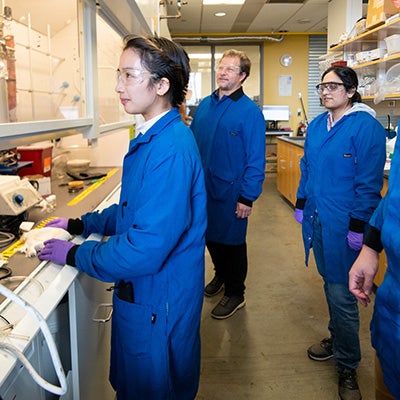
“We might be trying to learn about [a material’s] chemistry and how the molecules react, see what kind of properties that material has,” he explained. “Or we might be trying to make a new kind of device, a new light-emitting diode or transistor or a new solar cell.”
With one foot in the global scientific community and another in the world's business and energy markets, Korgel offers a unique perspective on the interplay between higher education, multinational research collaboration, energy sustainability and technology commercialization.
Building an International Circuit
Global engagement shaped Korgel’s career from the start. After earning a Ph.D. in chemical engineering from UCLA in 1997, he conducted postdoctoral research at University College Dublin in Ireland, an uncommon path for engineers at the time.
“I was living outside the United States, which I didn't think I was going to do,” said Korgel. “Living abroad was not something a lot of [engineering students] pursued then, but I had that opportunity, and it really opened up my eyes to the rest of the world.”
With his wife and two young sons, Korgel moved to Dublin and began work on a project funded by the European Union, involving a European network of collaborators in Italy, Ireland, Sweden, Switzerland and the United Kingdom. He credits a foundational shift in mindset to these early experiences working abroad among the worldwide scientific community.
“Collaborative research frameworks were evolving much faster in Europe at that time than in the United States,” said Korgel. “The European Union was trying to think, ‘How do we foster and support collaboration between research groups in different universities across national borders with unique strengths, specialties and ideas?’ ”
Korgel returned to the U.S. in 1998 to join UT Austin as an assistant professor. In 2007, he went abroad again as a Fulbright Senior Scholar at the University of Alicante in Spain.
“I didn't come back to the U.S. for eight months,” said Korgel. “I was able to hop over to different countries in Europe and give seminars and meet people. My Fulbright [fellowship] and Spanish hosts expanded my international network tremendously.”
In the late 2000s, Korgel returned to the University of Alicante as a visiting professor, soon adding appointments and lectureships at institutions including Université Joseph Fourier in France, the Chinese Academy of Sciences in Beijing and National Tsing Hua University in Taiwan. He has published more than 320 papers and delivered more than 330 invited lectures worldwide.
Global Technology Valorization
Korgel’s work also extends into entrepreneurship. As the founder of two nanotechnology companies, his informed perspective on technology “valorization” enhanced his former role as director of the Nanotechnologies area of the UT Austin Portugal Program, and current role directing the new Clean Energies area.
“Valorization is a word commonly used in Europe, but not here in the U.S. as much,” explained Korgel. “Valorization is taking technology from a lab and getting it into the commercial sector.”
Established in 2007, the UT Austin Portugal Program has expanded for nearly 20 years through five-year funding phases. During the first phase of the program, the governments of Portugal and Spain established the International Iberian Nanotechnology Laboratory and located it in Braga, Portugal. At that time, Korgel was tapped to direct a new Nanotechnologies area at the start of Phase 2.
“Through this role, I met a lot of researchers, students and policy leaders in Portugal, trying to understand what's being done in nanotechnology: What were the strengths? What were the different universities doing?” Korgel recalled.
“Paul Vilarinho from the University of Aveiro was instrumental in this, introducing me to so many experts in the country. This led to significant growth of the Nanotechnologies program in Phase 3 of the program. I think it’s been very successful at building new collaborations between Portuguese and UT Austin researchers.”
Recently renewed for a fourth phase, the program expanded to include Clean Energy, another area in which Korgel has deep experience and now leads alongside his directorship of the UT Energy Institute.
He emphasized the program’s value for UT students and faculty — as well as the University’s interdisciplinary research — through reciprocal exchanges and funded opportunities for collaboration.
Gifts of Reciprocation
Across Korgel’s roles, his empathy and excitement for the experience of international students shines through, alongside a keen awareness of the benefits that such connections bring to the University community.
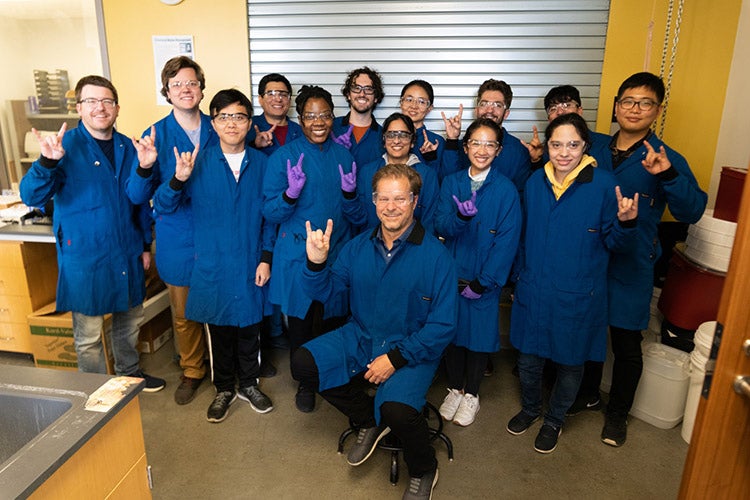
“What do we do at UT? We're really educating the next generation of leaders,” said Korgel. “I've graduated 54 Ph.D. students, many of them international students from all over the world, as well as students from the U.S., and they’re doing really great things.”
Korgel has hosted dozens of visiting researchers in his lab, including graduate students, postdoctoral scholars and faculty on sabbatical, and sent many Longhorns to other countries on reciprocal exchange. He attributes the success of these exchanges largely to UT’s strong infrastructure for international engagement.
“My research group, we host people all the time ... and we do a lot of exchange both ways. It's a really great way to collaborate and exchange information,” he said. “I know personally what it's like to go abroad, and how important it is for that host institution to provide support. UT's got a good framework for hosting visiting scholars.”
Fostering Transnational Viability
Study abroad is another pillar of Korgel’s global engagement. For the past decade, he has led a May Term course, “Advanced Nanotechnology and Innovation for Beginners,” which fuses nanotechnology concepts with principles of innovation, entrepreneurship and intellectual property — all within a global economic context.
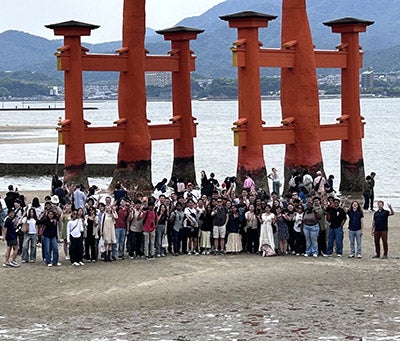
“I want to provide the opportunity to as many undergraduate students as possible — from different degrees, different years, from across the entire Forty Acres — to gain an international experience in a setting where I can teach them things I'm passionate about — nanotechnology, innovation, entrepreneurship, international partnerships and collaboration — in a way that [incorporates] an authentic living experience,” said Korgel.
Implementing group work, public speaking and cultural exploration, the course has been held in Spain, Japan and Denmark, ultimately returning to Japan after the pandemic. Post-COVID demand prompted expansion from about 20 students to nearly 80 students from a wide range of majors.
“This year we have about 60 students enrolled ... from at least 10 or 11 different majors,” said Korgel. “They address societal challenges by thinking of novel technology solutions and pitch a startup company at the end of the month, and they're diving into Japanese culture all the time.”
Korgel leverages his connections in Japan to further enrich the experience by connecting students with local undergrads studying English and sponsoring visits to local firms, including the headquarters of Tokyo Electron (TEL).
“The first year, the CEO of Tokyo Electron was curious, and he came and met all the students," said Korgel. “TEL does an amazing job hosting our students for a day, giving them insights about living and working in Japan as an expat ... they give our students a deep dive into the new technology innovations in semiconductors that TEL is leading and commercializing, while also talking about their experience of what it's like to work and live in Japan.”
Texas Global Alumni Summit
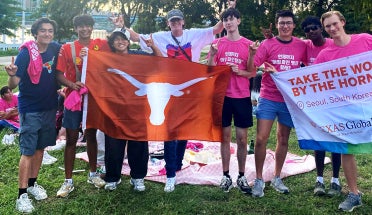
In April 2026, Korgel will speak at the Texas Global Alumni Summit in Seoul, South Korea. This inaugural celebration of UT Austin’s international alumni community will feature plenary sessions, panels and showcases addressing innovations in artificial intelligence, global energy transitions, health in the digital age, semiconductor ecosystems and the worldwide K-culture phenomenon. Attendees can also participate in networking opportunities and cultural excursions.
At the summit, Korgel will highlight a new partnership between the UT Energy Institute and Korean Southern Power (KOSPO) with a discussion focusing on energy infrastructure for the global semiconductor ecosystem and growing energy demand forced by the expansion of AI data centers.
“There’s a lot of focus and interest in semiconductors in Korea, as well as on energy,” said Korgel. “I'm really looking forward to going over there, because I wear both those hats: energy and semiconductors.”
Cultural Competence as Imperative
For Korgel, global cultural competence is essential for the professional success of both students and graduates.
“To be successful, you really need to be comfortable living abroad ... or certainly traveling abroad and meeting new people with different perspectives,” Korgel said. “You have to be a global citizen. It's just required these days, especially if you're a scientist or an engineer.”
That mindset extends beyond research to the business world, as international cross-pollination of ideas is what drives innovation forward.
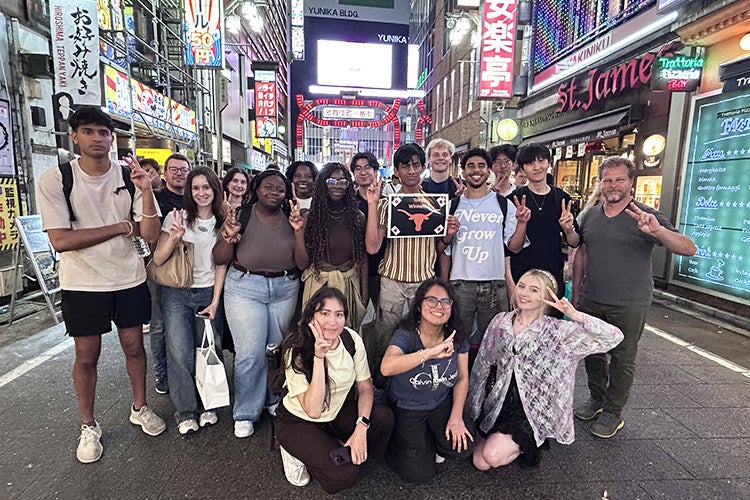
“It's become really important for our students to know how to succeed in a global environment,” he said. “To thrive and move up as a leader in today’s companies, they need to understand what it's like to work with people from other countries and to innovate and problem-solve collaboratively.”
Ultimately, Korgel believes cultural understanding and transnational connection are central to the University’s mission.
“I think UT is an amazing place for innovation and international collaboration,” he concluded. “What starts here changes the world ... And the only way that can happen is if we have really strong global engagement.”