Building Smarter Cities with Professor Junfeng Jiao
- Aug 12, 2025
- Education Abroad
- by Alex Briseño


“I encourage all of my students to go experience the world. It is so big, and we only live once, so we should all go out and experience as many parts of it as we can. To travel and speak with people of that region, it is another way of learning.”
When Professor Junfeng Jiao explains the basics of a digital twin — a cutting-edge virtual replica of real-world urban environments created with data and simulations — he often likens a digital twin model of a city to a stack of old-fashioned pancakes.
“Each layer — water, housing, electricity, transportation, people — can be modeled digitally,” Jiao says. “This gives you the ability to simulate when something goes wrong and investigate how to respond. That is the future.”
This type of tool provides cities with the opportunity to build more resilient infrastructures and better prepare for natural disasters.
The concept of smart cities is based on the integration of emerging technologies to drive a city’s growth in the pursuit of environmental, economic and social development. This is just one of many research interests for Jiao, an international expert on smart cities, urban informatics and ethical/generative artificial intelligence.
Pioneering the Future
Founding director of the School of Architecture’s Urban Information Lab, Jiao is also the director of Texas Smart Cities and director of the University's Ethical AI program. In addition to international recognition in his field, Jiao’s smart city research earned him the role of Fulbright specialist on smart cities, as selected by the U.S. Fulbright Foreign Scholarship Board.
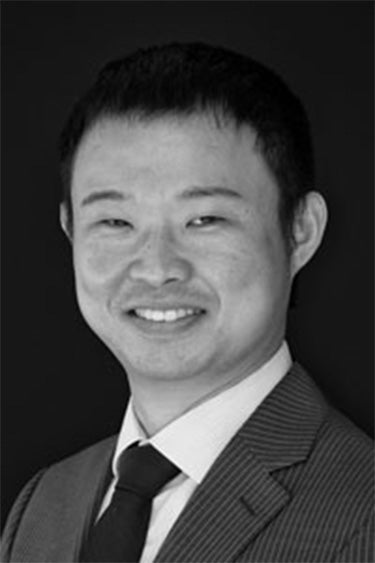
Technically, he is quantifying urban infrastructures and their influences on people’s behavior with various information technologies. But to put it plainly, Jiao is pioneering the future from the Forty Acres.
In other words, he said with a smile, “I use technology to make better, smarter and more livable cities. Whether it's transportation, AI or informatics, I use technology in an effort to make all resources easy, fast, safe and more enjoyable for everyone.”
Jiao is also celebrated on campus as a champion of global engagement. His body of work, collaborative philosophy and belief in international education led to several transnational projects in 2024, including a President’s Award for Global Learning project in Japan and a Faculty Research Seed Grant from Texas Global.
Originally from China, Jiao holds bachelor’s and master’s degrees from Wuhan University, a master’s degree from the University of Twente in the Netherlands and a master’s and Ph.D. from the University of Washington.
After earning his doctorate in 2010, Jiao spent two years at Ball State University as an assistant professor. In 2013, he joined the UT School of Architecture, where he is now a tenured professor in the community and regional planning program.
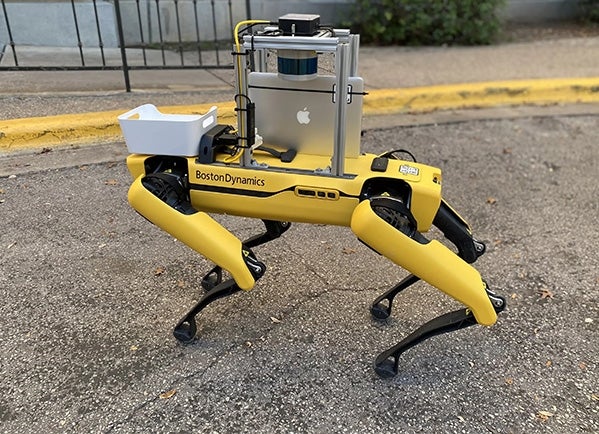
Jiao and his team’s developments include ComputeGPT and OpenCityAI, two generative AI systems run at the Urban Information Lab; an autonomous dog-like robot delivery system; and the Austin Fire Digital Twin.
He also coined the term “transit desert,” used to describe areas lacking adequate public transit service for a large transit-dependent population. Using spatial data analysis, Jiao applied this framework to every major U.S. city and provided a score.
“Transit desert is a concept I created that categorizes into two types,” Jiao said. “The first type is neighborhoods with no transit whatsoever. Type two is usually a larger community, like Manhattan or San Francisco, where transit exists but the demand is so much higher that there remains a gap.”
Building a Safer Austin
Jiao also led one of the six research projects launched in 2021 by Good Systems, an initiative established at UT Austin in 2016. The initiative remains focused on defining, evaluating and building ethical AI systems that will transform societies while minimizing damage and unintended consequences of new technologies.
Jiao's project, “A Good System for Smart Cities,” proposed a new fire tracking and forecasting platform called FireCOM, which utilizes real-time data on fires and combines it with weather information to accurately predict and issue early warnings for projected smoke fallout across the ensuing hours.
"You can have a digital twin of cities, airplanes, even human bodies,” Jiao said. “Then you can run simulations in digital environments and use the results to guide your actual decision-making process.”
In action, that looks like Jiao and Austin Fire’s collaboration on a digital twin of the city of Austin. Live data is collected from active fires, then the model updates automatically and runs simulations to project how much smoke and damage a specific fire could generate in the crucial hours that follow.
The primary function of the tool is to serve as an early warning system. However, it simultaneously creates a safer city by providing first responders with information they need in real time.
“Austin Fire uses that data to make predictions and design a game plan regarding evacuation routes and reducing damage,” Jiao said. “That was the purpose of this specific digital twin project, and Austin Fire actually still uses it to monitor fires.”
Experiential Learning
In 2024 alone, Jiao executed several projects around the world. As a faculty recipient of the 2023-2024 President’s Award for Global Learning, he led a team of students and faculty to Japan to pursue a project in partnership with Tokyo Metropolitan University. Then, a Faculty Research Seed Grant from Texas Global led to a collaboration with Tecnológico de Monterrey in Mexico.
“I feel very fortunate because I found my way to Texas Global, which is how I learned about the President’s Award for Global Learning,” Jiao said, highlighting the International Board of Advisors’ signature program that combines interdisciplinary faculty collaboration, transnational institutional partnerships, and cross-cultural work and research opportunities for students.
“The Sustainable and Resilient Smart City in Japan” project focused on disaster-resilient smart city development in Japan by studying Aizuwakamatsu, a smart city in Fukushima Prefecture, along with the Toyota Woven City, a “mass human experiment” and test course for mobility.
“We were impressed by how awesome the infrastructure system was, all over Japan,” Jiao said. “We learned a lot. Students left that trip wanting to trade their vehicles for a thriving public transit system.”
Jiao and the team spent the month of June 2024 traveling throughout Japan, from Hokkaido, the northernmost island in the country, to Tokyo and Fukushima.
“It’s very rewarding to experience these things with students and faculty,” Jiao said. “The students come back more mature. They become more open-minded, and some have completely different career trajectories.”
Jiao added, “I encourage all of my students to go experience the world. It is so big, and we only live once, so we should all go out and experience as many parts of it as we can. To travel and speak with people of that region, it is another way of learning.”
‘Awesome things happen when we bring people together’
Just afterward, in fall 2024, Texas Global supported Jiao with a Faculty Research Seed Grant, awarded to UT faculty members who are conducting international research with peer collaborators on the faculty at institutions abroad, advancing the University’s global engagement efforts.
The seed grant funded a collaboration between UT and Tec de Monterrey, allowing the two institutions to build city models of both Monterrey and Austin.
“We’re trying to see what we can learn from each other, specifically for energy consumption, usage, storage and safety,” Jiao said.
In Jiao’s words, “We should never stop learning from one another.” This project is merely the latest display of that philosophy, one that embraces the power of reciprocal and experiential learning, international education and collaboration.
“Texas Global continues to bring together faculty and students both locally and globally, and awesome things happen when we bring people together,” Jiao said. “I am truly blessed to receive the [President’s Award] and seed grant funding. It’s allowed me to interact with people from all around the world. This work and the people I get to do it with make me happy, because these are the things that expand my life.”