Alum and Peace Corps Volunteer Leads Equine Therapy in Ecuador
- Mar 5, 2026
- Peace Corps
- by Riddhi Bora


Editor's Note: In honor of Peace Corps Week 2026, we're featuring stories of Peace Corps Volunteers from the Forty Acres.
For recent Longhorn alum Natalie Taylor (B.A. '23, Spanish), two things have remained constant in her life: her passion for speaking Spanish and her dedication to community service.
During her junior year of high school, Taylor participated in an exchange volunteer project in Nicaragua and years later studied abroad in Argentina while earning a Bachelor of Arts in Spanish at The University of Texas at Austin.
While balancing her UT coursework, Taylor served as a case manager at Casa Marianella, an Austin shelter for immigrants. She also volunteered at Healing with Horses Ranch, working in equine therapy — a treatment method that uses hands-on interactions with horses to improve patients’ physical and mental well-being.
While in Argentina, Taylor had strengthened her Spanish-speaking skills by volunteering at an orphanage and participating in an equine therapy program there. She said that experience, which stoked her love for volunteering and desire to travel abroad again, inspired her to join the Peace Corps, an independent federal government agency that sends volunteers from the United States to work alongside community members in partner countries for 27 months.
Specificity Yields Targeted Impact
Taylor joined as a Peace Corps Volunteer after graduation and now spearheads the “Empowering Youth with Disabilities” project in Ecuador. Under the program, children with disabilities spend time with horses, assisted by volunteers from the local law enforcement community.
“When they found out that I had a background in equine therapy, it was an exchange of knowledge,” Taylor said. “It was like, ‘This is how we do it in the U.S. This is how we do it here, and we can work together to create a program that’s more effective.’ ”
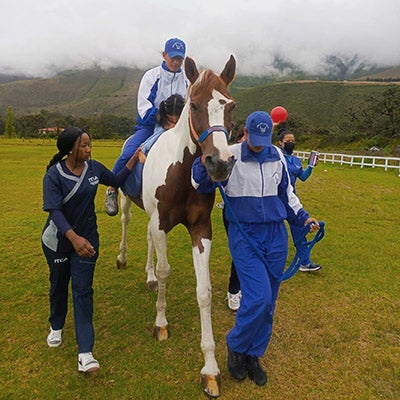
The Ecuador project’s primary objective is to provide specialized training to local mounted police officers. Taylor said that because the police have not received specifically targeted training, all the kids in the program — who arrive with conditions as disparate as autism, ADHD and cerebral palsy — receive the same therapeutic treatment despite their vastly different needs. The goal is to create a long-lasting impact that not only satisfies particular needs but also reaches beyond the local community.
“The idea is that [eventually] the police can train other police officers in different units around the country, and it becomes a pilot program for other police working in equine therapy in Ecuador,” Taylor said. “The idea is that it [becomes] a model for change in the field.”
Although her Peace Corps assignment is set for two years, Taylor said she is considering extending her stay in Ecuador for an additional year to ensure the project’s sustainability.
Holistic Evaluation and Collaboration
To assess the effectiveness of the Empowering Youth with Disabilities initiative, program volunteers and participating police officers implement a holistic evaluation strategy that measures, on a scale of 1-5, the emotional effects of the equine therapy experience for kids.
Implemented at the beginning, middle and end of the 10-month therapy period, the evaluation examines the children’s sensory, motor, cognitive, and creative skills, as well as their ability to regulate emotions, act independently and take initiative. This assessment system also allows families to get involved through surveys and to monitor and gauge their children’s capacity for self-care. Parents are also invited to participate in self-care initiatives.
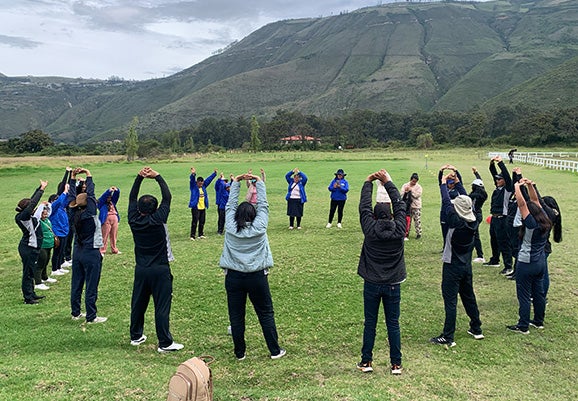
“We have done one workshop for moms with a local psychologist where we talked about self- care, and we got lots of good feedback,” Taylor said. “The moms said they felt they were able to be themselves, be honest, talk about the struggles they have at home, feel accompanied by other moms who deal with similar things, and make realistic plans for taking care of their mental health.”
Client families can also increase their participation through visits to an on-site therapeutic garden that allow kids to manage stress through activities such as seed planting. Taylor said she’s noticed that the program’s children, parents and caregivers all appreciate spending time in the garden.
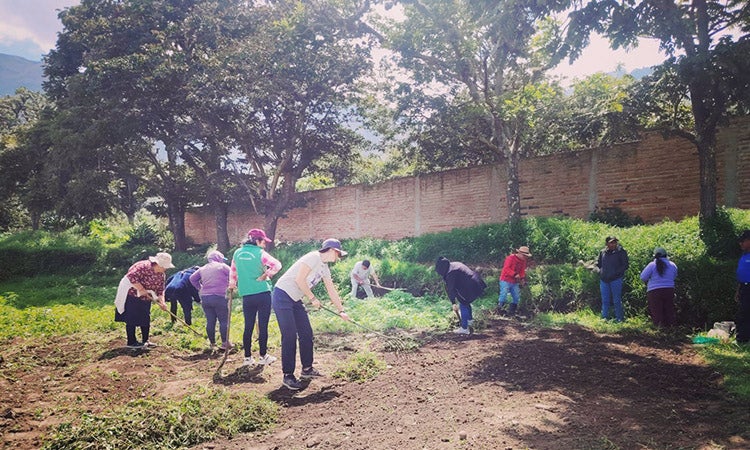
“Youth participants have enjoyed planting and caring for the plants as they grow and have been practicing empathy and taking responsibility for the community garden,” Taylor said.
The garden is partially supported by Ecuador’s Ministry of the Environment, one of many groups helping with the plan, whose stakeholders also include psychologists, physical therapy and education interns, and bus drivers who transport children to the therapy facility.
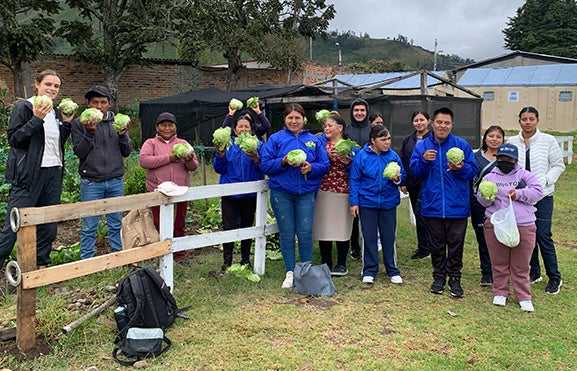
“There are a lot of different actors,” Taylor said. “The idea is really bringing people together, getting on the same page, educating a bit more about what equine therapy is, and hopefully creating a sustainable program.”
Finding a Focus for the Future
Taylor described her Peace Corps service as a once-in-a-lifetime experience that has broadened her perspective and challenged her to step outside her comfort zone.
“When I was about to graduate, I wasn’t exactly sure what I wanted to do next. There’s so much pressure to know,” Taylor said. “I knew I liked working with kids, but I didn’t really know in what capacity and how and in what settings.”
She said her time with the Peace Corps influenced her post-graduation plans by giving her a low-pressure space to explore her interests. Now she knows that moving forward, she wants to participate in a dual program combining social work and law to work with unaccompanied minors to support their legal cases.
“Coming to the Peace Corps, I got to try working in a school, an organization, and in therapy,” Taylor concluded. “Now I have a better idea of what I want to do afterward, and I’ve learned so much.”