Uncovering Oplontis: UT Researchers Revisit Life Before Mount Vesuvius
- Oct 15, 2026
- Avrel Seale, UT News


In 1599, workers near Naples, Italy, were constructing an underground canal and accidentally discovered Pompeii, the ancient city that was buried under ash and pumice after the catastrophic eruption of Mount Vesuvius. It was formally rediscovered and targeted for excavation in 1748, and ever since, the public has been fascinated by the macabre story of August24, 79 C.E., and the time capsule that the Vesuvius cataclysm created.
Nowadays, cruise ships dock in Naples, and buses haul tourists to the site by the thousands. To the west, the smaller site of Herculaneum, which suffered the same fate, gets its share of traffic, too.

Between the two, another site was discovered in 1964, known from ancient maps as Oplontis. One UT professor and his former student are among the world’s foremost experts on this lesser-known but hugely important site.
For 21 years, John R. Clarke and Michael L. Thomas have co-directed the Oplontis Project. Clarke joined the UT art history faculty in 1980, and the Annie Laurie Howard Regents Professor of Fine Arts is still going strong at 81. Thomas, whose doctoral studies were supervised by Clarke and culminated in 2001, is now a professor at The University of Texas at Dallas, where he also directs the Edith O’Donnell Institute for Art History.
National Geographic featured the Oplontis Project as part of its cover story “Vesuvius Revisited: A New Story of the Day the World Exploded” in its August 2026 issue. The project involves travel to Oplontis at least once a year for excavation and preservation, but also digging through archival photos taken since the discovery to solve archaeological mysteries, and creating a digital twin that students can use to explore the site.
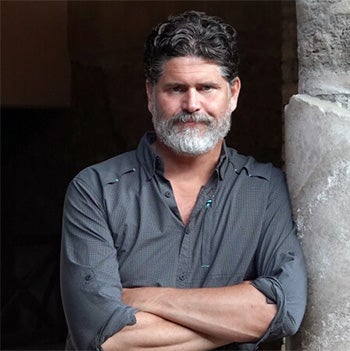
In 2005, Thomas, who was then working on a postdoctoral fellowship at Tufts University, persuaded Clarke to ask the site director if they could work there together. Clarke was well connected in Pompeii, says Thomas, “and I had experience running field projects. I said, ‘Why don’t we find something and do it together?’ That was the birth of the Oplontis Project.”
Clarke raised money from Texas donors, the National Endowment for the Humanities and British sources to fund the study.
“This is the 1% of ancient Italy,” says Thomas about the grandeur of finds on the site. “Make that the 0.5%. So, you’re seeing luxury on an enormous scale.”
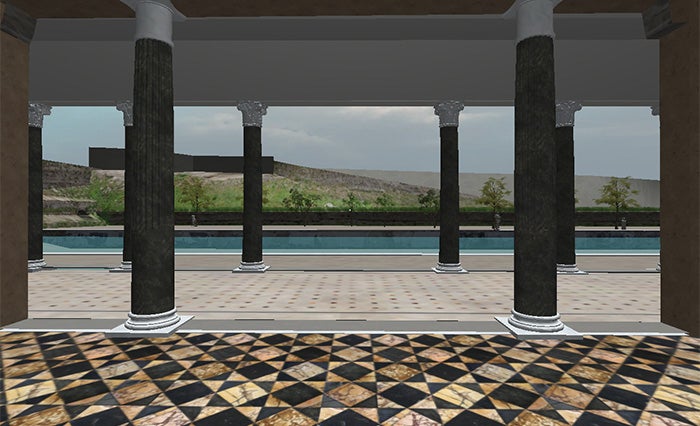
At Oplontis, which sits underneath the modern town of Torre Annunziata, there are two sites under study: One, Villa A, is an opulent 40,000-square-foot complex with courtyards and a 60-meter swimming pool. It holds no remains except those of an unlucky cow. Villa A also boasts a large living area for enslaved servants. The other site, Villa B, was a wine-bottling facility where workers washed, dried, recoated and refilled large clay wine jars called amphorae. At Villa B, some 60 people perished.
Clarke describes excavation to his students as a “squashed sandwich.” Digging down, the first thing found were roof tiles, then the upper story with strata including rotted wooden beams and evidence of the floors.
One day, which Clarke remembers as “the best day of all,” the archivist at Pompeii said, “I think I have something for you.” It was a big package from the estate of archaeologist Alfonso De Franciscis, who had mistakenly sent it to the German Archaeological Institute in Rome years earlier instead of to Pompeii. In that packet were photos of the original excavations from the 1960s. From these photos, Clarke was able to establish important facts about the sequence of the excavation before it had become scientifically systematized in 1972.
To learn more, read the story on UT News, or see the original feature, “Vesuvius Revisited: A New Story of the Day the World Exploded,” on National Geographic.