Texas-Sized Summit Unites Alumni in Seoul
- Aug 6, 2026
- Global Alumni Relations
- by Ellen Stader


Tucked beneath the curve of a hotel tower in Seoul’s business and shopping district is a three-story, octagonal shrine encircled by a stone fence. The ornate green, red and blue of its traditional wooden dancheong design glows warmly against the golden-hued glass of the hotel façade, and the upswept curves of the temple’s eaves anchor the skyscraper’s soaring planes.
These unlikely neighbors are Hwanggungu, part of the “Temple of Heaven” shrine built in 1899, and the Westin Josun Seoul, Korea’s first Western hotel, constructed in 1914 and remaining today a symbol of modern style.
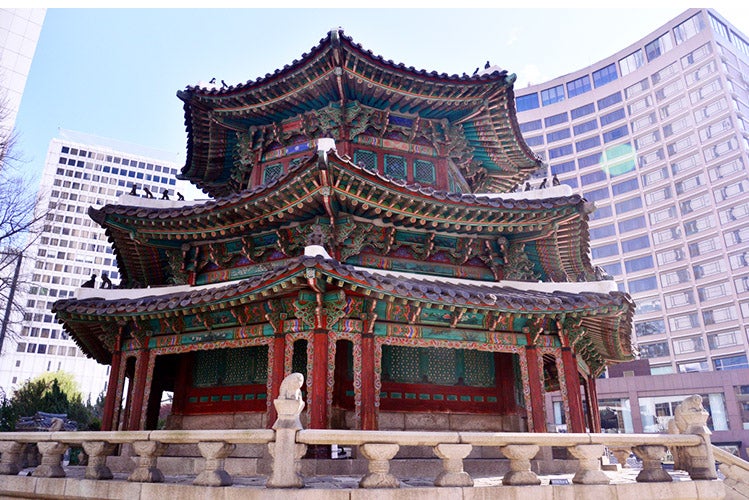
The striking juxtapositions — traditional and progressive, Eastern and Western, spiritual and commercial — made this a fitting location for a global gathering of people from vastly different backgrounds who share a single, common goal: connection.
Connection Across Continents
In April 2026, at this nexus of influences, The University of Texas at Austin gathered more than 120 alumni, industry leaders and academic partners from 15 countries for the inaugural Texas Global Alumni Summit: Innovation Across Borders. The two-day event was organized by Texas Global, the organization that leads and supports the University’s internationalization efforts.
Working from a strategy connecting academic research, industry collaboration and alumni leadership across regions, the summit marked a milestone in UT Austin’s growing engagement with Korea and the Asia-Pacific region.
“This gathering celebrates the strength of our global Longhorn alumni community and the partnerships that turn bold ideas into meaningful action, while honoring the deep, enduring relationship between UT Austin and Korea,” said Sonia Feigenbaum, senior vice provost for global engagement and chief international officer.
With a proven dedication to partnerships, Feigenbaum continually explores new avenues to broaden UT’s global reach in research and collaboration. She has long nurtured and promoted the affinity between UT Austin and Korea.
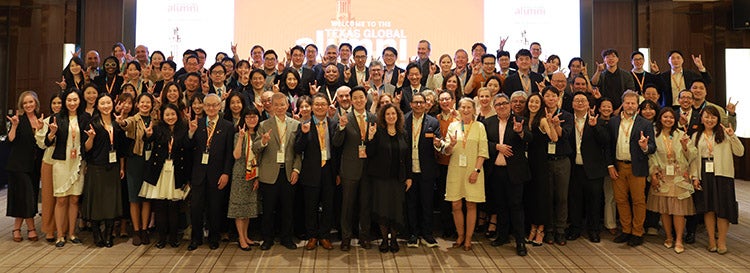
Describing the summit’s effect on attendees, Feigenbaum said, “The energy and pride of our alumni, faculty and campus leadership were palpable. This event has connected alumni all over the world, and there was a sense of community and appreciation for what UT Austin is doing academically.”
Summit participants included UT Austin alumni, students, professors and campus leaders, as well as faculty counterparts and corporate representatives from across the region. Attendee origins spanned the United States and nations across Latin America, Europe, Africa, Asia and Australia, highlighting UT Austin’s expanding global alumni and innovation network.
Access and Opportunity
The first of its kind, the summit beckoned Longhorns living across the world to gather, connect and share ideas. Some alumni came to Seoul looking forward to reconnecting with old friends. Others enjoyed the chance to revitalize connections with their alma mater by meeting fellow alumni, current or prospective students, UT faculty and leadership, or industry thought leaders in their field.
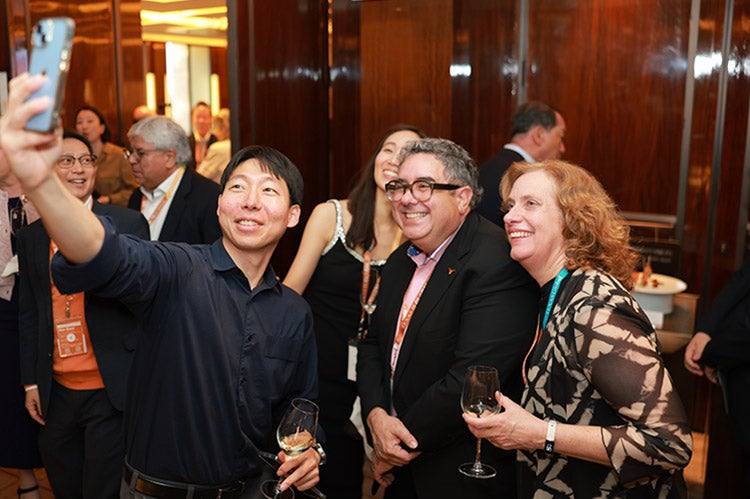
“At my table yesterday, I met so many people from Tokyo, from Taiwan, and just talking about experiences, I think, is such a good way [to connect],” said Motolani Adedipe (Ph.D. '16, health outcomes and pharmacy practice). “To be here in person and to be with people and talk about all kinds of things: Nothing beats the experience.”
Adedipe, now an associate professor at the University of Oklahoma Health Sciences Center, conducted research as a Fulbright Scholar at Seoul National University Hospital.
She concluded, “To have this connection with alumni, senior colleagues, people who have done such great things in the world, and to have them gathered together, it's almost like tapping into the world of wisdom.”
For students as well, attendance at the summit offered unprecedented access to University luminaries, prospective employers, research partners and numerous possibilities, both academic and professional.
“It opens my eyes to the opportunities that are going to come to me,” reflected recent grad Joseph Song (B.S.A. ’26, human development and family sciences), then studying in Seoul as an exchange student at Korea University. “As a former student but also an incoming medical student, to learn so much from these different perspectives — and then take this home and connect it to my life and my future career — is exciting.”
As an alum and current professor of dance theory at San Diego State University, speaker Chuyun Oh (Ph.D. ’15, performance as public practice) considered the summit opportunities from student, alumni and faculty perspectives, summing up her hopes for imparting both knowledge and wisdom to students during an academic career.
“It is such a long journey. And I think what we learn throughout, especially as graduates of the program, is not just about academics, not just about theory. We actually learn more about who we are through those long years of training and academic study,” said Oh. “I'm hoping that international students will be able to find not just their own unique pathway as an academic but also find themselves and their voice.”
A Natural Pairing
UT Executive Vice President and Provost William Inboden lauded South Korea as a fitting host for the inaugural alumni summit. Before taking the provost role, he worked closely with Korean diplomats and leaders for three decades as a policymaker with the U.S. Department of State and the National Security Council.
“Global progress depends not only on new ideas and innovation, but also on trust, partnership and shared responsibility,” said Inboden. “The Republic of Korea has emerged as a vital global leader at the crossroads of security, technology, economic dynamism and democratic resilience. Its role in sustaining regional stability and driving global progress make Seoul a perfect place to launch a summit dedicated to innovation across borders.”
John Kim (B.S. ’05, petroleum engineering), president of the UT Austin Korean Alumni Association, echoed those sentiments in his role as an ambassador for visitors. He pointed out that while Texas is among the fastest-emerging states in the U.S., Korea is one of the fastest-growing countries in the world, both economically and culturally.
“I think Texas and Korea share some commonalities,” said Kim. “They love challenges. They value freedom. And they're very open to opportunities.”
He also cited Korea’s lightning-speed growth, climbing into the Top 10 of global economic powers in less than 80 years after the Korean War, and partially attributed the country’s commercial renaissance to early U.S. academic support. This growth has propelled Korea to the forefront as a world leader in both technological innovation and popular culture.
UT Austin maintains longstanding ties to Korea across education, research, innovation and alumni engagement. Korea is the third-largest source of international students and scholars at UT Austin, and more than 75 UT faculty members are actively engaged in Korea-related research and creative activity.
More than 1,000 Longhorn students have studied in Korea during the past decade, and today more than 3,000 UT alumni reside in Korea, constituting one of the University’s largest and most dynamic global alumni communities.
Reflecting the deep institutional ties between UT Austin and leading Korean universities, representatives from Hanyang University, Korea Advanced Institute of Science and Technology (KAIST), Korea University, Sungkyunkwan University, Ulsan National Institute of Science and Technology (UNIST), and Yonsei University attended the summit. Hanyang University hosts UT’s Take the World by the Horns program, which welcomes more than 50 Longhorn students each year to start their college careers with a semester in Seoul.
Business and corporate partners rounded out the roster of panelists and presenters, including Kim, who serves as chairman of primary summit sponsor the Kaiper Group, as well as representatives from Samsung Electronics and Dongjin Semichem. Event sponsors also included alumni-led and Seoul-based companies Pentalink, Greenergenic and Blackboard Asset.
Innovation Across Borders
Senior University leadership, industry executives and academic partners engaged in discussions examining the role of collaboration between industry and academia in semiconductors, artificial intelligence and health, energy systems and the creative economy. The resulting dialogues proved both illuminating and unifying.
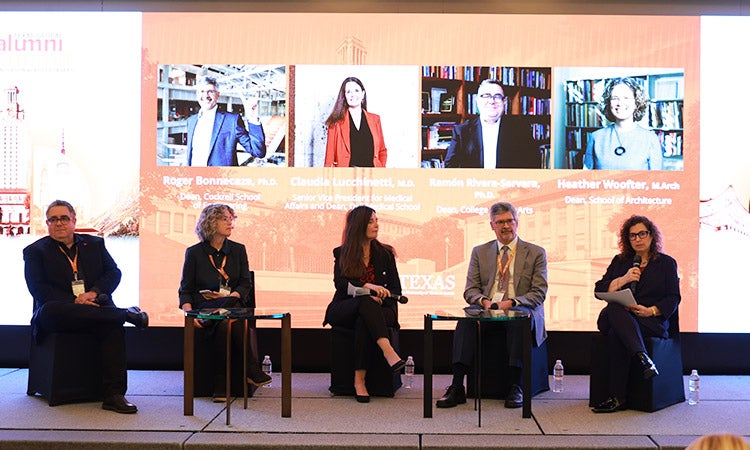
“Global partnerships expand the impact of UT Austin with new perspectives, new voices, new opportunities,” said Fiona Mazurenko, director of Global Initiatives and Alumni Relations at Texas Global. “These partnerships allow UT to contribute to solving global challenges, ensuring that knowledge, innovation and opportunity flow between our campuses, countries and communities.”
A key focus was UT Austin’s central role in the evolving global semiconductor landscape and the emerging Korea-Central Texas innovation corridor. The panel “Powering the Future: UT Austin and the Global Semiconductor Ecosystem” examined how universities and industry partners contribute to precompetitive research, workforce pipelines, and technology translation across the semiconductor value chain.
The session featured corporate representatives from Samsung Electronics and Dongjin Semichem. Roger Bonnecaze, dean of UT Austin’s Cockrell School of Engineering, moderated the session and focused on the relationship between academia and industry with a clear perspective.
“I'm excited about being here in Korea because of their excellent universities and their world-class manufacturing, which is important for partnerships around education, research and translating our work into practice,” said Bonnecaze. “Global partnerships are important to the engineering school, both in terms of education and research. Working with a variety of companies around the world means that we will have a global reach in terms of our impact.”
UT Energy Institute Director Brian Korgel, who led “The Global Energy Transition” session, also spoke to the opportunities the summit offered to build and bolster alliances across sectors.
“I'm looking to expand partnerships in Korea,” said Korgel. “With the Energy Institute, we have a variety of industry partners — Korea Southern Power is a member of the Energy Institute — and I'm looking to build stronger connections with Samsung, for example, and other Korean industries in the energy sector.”
Pivoting from his director perspective to his role as professor of chemical engineering, Korgel further addressed the value of institutional agreements between universities: “When we're talking about international engagement — with KAIST in Asia and Korea — those partnerships are important. They crank up our international collaboration. They provide a framework for student and faculty exchange.”
Interdisciplinary Collaborations
Similarly, Claudia Lucchinetti, senior vice president for medical affairs and dean of Dell Medical School, expressed an appreciation for the expansive nature of collaboration offered at the summit. During the session “AI, Digital Twins, and the Future of Health,” she spoke with Charles Taylor, director of the Center for Computational Medicine.
“I was struck by the many opportunities that emerge as we begin to think about how we're going to train the next future of doctors, [comparing] how they’re doing it in Korea and how we’re doing it,” said Lucchinetti. “It’s a recognition of the importance of education and training future generations in a global mindset. Part of the opportunity to expand education and impact is to embrace the idea that the challenges of the world are global in nature.”
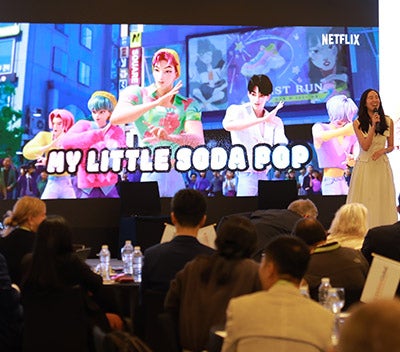
During “Globalizing K-Pop Entrepreneurship: From Austin to Seoul” — an engaging presentation that incorporated music, video and audience participation in K-pop choreography — alum Chuyun Oh discussed UT Austin’s engagement in the global creative economy with Ramón Rivera-Servera, dean of UT Austin’s College of Fine Arts.
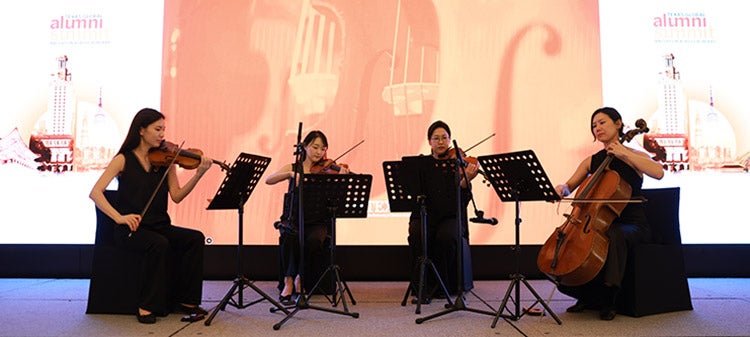
The conversation examined cultural entrepreneurship, artistic education and international creative markets through the lens of the juggernaut K-pop industry, and the session followed a special performance by the Risus Quartet, a celebrated South Korean string ensemble composed of UT alumni.
Rivera-Servera later spoke of the enlightening experience of accompanying fellow deans Lucchinetti, Bonnecaze and Heather Woofter from the College of Architecture as they exchanged expertise during visits with colleagues and counterparts at several Korean universities.
“What’s interesting about meeting these groups of leaders is that we were trying to identify points of interdisciplinary collaboration," said Rivera-Servera. “The opportunities to amplify the projects that we're pursuing together get more exciting and more impactful as they accrue collaboration along the way.”
Woofter shared these sentiments about aggregating viewpoints and resources via global collaborations, framing them also in terms of the benefits they offer students.
“The exchange of faculty, in terms of their research: We have many planners working on projects across Asia — looking at smart cities, for instance,” said Woofter. “And in terms of our students: Their ability to be outside of Texas, as much as they’re learning about the state, I think it's also important for them to be in a completely different environment.”
Only the Beginning
Participants and presenters alike pronounced UT Austin’s inaugural alumni summit a resounding success for fostering connections between partners, strengthening ties with Korea, offering unique cultural experiences and convening innovative thought leaders across industries.
Students took advantage of unprecedented access to potential mentors and research partners and employers. Alumni reunited with each other, campus figures — and their Longhorn pride. Faculty and campus leaders connected with peers from universities across the globe and across campus, discovering additional avenues to expand student educational and employment opportunities.
“This summit is far more meaningful than a single event. It took seven years of sustained engagement and deliberate community-centered work, connecting alumni here and across the region through many platforms, conversations and collaborations,” said Feigenbaum. “It is a milestone, but it is also a continuation, with a simple but ambitious goal: to strengthen The University of Texas at Austin's relationships with its alumni and partners around the world — intentionally, and for the long term.”
Texas Global is thrilled to announce the next Texas Global Alumni Summit: London, April 15-17, 2027. Save the date and find more details on the Texas Global Alumni Summit page.