UT Austin’s French Connection Displays Impact of Global Partnerships
- Apr 9, 2026
- Global Engagement and Strategy
- by Alex Briseño


When Sonia Feigenbaum arrived at The University of Texas at Austin in 2019 to serve as the inaugural senior vice provost for global engagement and chief international officer, she had already transformed international engagement at several public and private universities.
Recognizing the power of partnerships and connection — as well as their impact on the success of a university’s global presence — she explored new avenues to broaden UT’s global reach in research and collaboration.
"Global engagement at The University of Texas at Austin is an inherent part of the success of the institution, and it's multipronged in the way that we work in international education. One of the aspects of global engagement is the cultivation of partnerships with institutions of higher education, research centers and governments both local and international."
Early in Feigenbaum's tenure, during an on-campus meeting with Vincent Michelot, Attaché for Higher Education at the French Embassy in the United States, the two discussed a partnership that could advance this vision. They identified a promising opportunity to create a robust institutional collaboration with the Institut des Amériques (IdA), a French consortium headquartered in Paris that advances intellectual exchange at a national, regional and global scale centered on research topics that bridge France with the Americas.
Created in 2007, the IdA includes a cohort of schools such as the French National Center for Scientific Research, Sorbonne Nouvelle-Paris, Campus Condorcet and Aix-Marseille University, Institut de recherche pour le développement, among others across France. The institute which represents more than 20 disciplines, set out to establish 12 centers across the Americas.
Michelot shared a proposal to establish a center at UT Austin: The IdA would send one or more fellows to UT for three years to conduct dissertation research in academic disciplines aligned with UT Austin’s academic work in the Americas.
Feigenbaum recognized the opportunity as a powerful point of synergy and quickly set out to expand and build upon the momentum. From that initial conversation, a UT-IdA transatlantic partnership took shape, establishing a Euro-American hub of higher education.
“I was really excited — it was one of the first agreements that we forged after I arrived,” Feigenbaum said. “It was a natural continuation of some of the work already in progress with France, such as the establishment of the Dr. Cécile Dewitt-Morette France-UT Endowed Excellence Fund.”
UT Austin and the Embassy of France in 2018 jointly created the Dr. Cécile Dewitt-Morette France-UT Endowed Excellence Fund, solidifying the commitment between the University and France to support joint discoveries and deepen historical ties between the nation and institution.
In Texas Global’s evolving relationship with France, Feigenbaum views the IdA partnership as one that leverages several of the University’s strengths.
“We have tremendous collections, libraries and resources all over campus, along with faculty who are connecting throughout the Americas,” Feigenbaum says. “We are also very strong in our engagement with Latin America and research in all academic disciplines."
She added, “Our IdA center is one that has attracted stellar fellows, so I thought the IdA would be a great outlet to strengthen our relationship with France while triangulating with the Americas.”
Bridging Partnerships
For Feigenbaum, the timing of Michelot’s campus visit was serendipitous. Less than one year into her new role at UT, she encountered the IdA opportunity at an intersection of topics and cultures she understands well as a Franco-American and a scholar of Latin America with professional experience in France, Korea and Mexico.
“I found it to be an interesting match that I felt we could really expand upon,” she said. “Everything I do is really connected to: What do we know? What do we have at this institution that can propel us forward in engaging with a certain region and topic?"
She continued, “The Institut des Amériques and our relationship with France are important to the University. Beyond being this bridge for me personally, it is one of the many great aspects of the work we do at Texas Global and The University of Texas at Austin.”
Meet the Fellows
UT Austin agreed to welcome two IdA fellows for the Spring 2026 term. Since 2019, these fellows have developed a reputation for arriving at UT Austin with the desire to meet faculty and make an immediate impact, Feigenbaum observed. What they also bring is a richness of perspective and intellectual curiosity that matches that of the scholars on campus.
“They’re eager to learn, but they’re also eager to take this experience back home,” Feigenbaum says. “It’s a really good feeling to know that our faculty here, their faculty in France at their institution, and our amazing team at Texas Global are all partnering to make sure we are advancing the career of these fellows to become successful academics, or have a hand in helping them choose what their next chapter is going to be.”
Florian Griffon and Augusto Britto are the two IdA fellows who will spend 2026-2029 conducting research at UT.
- Florian Griffon

Florian Griffon, who is a French Ph.D. student at the University of Sorbonne Nouvelle Paris, focuses his research on voting behavior in the United States. His work aims to provide a theoretical framework to explain counterintuitive voting outcomes. In other words: cases in which voters unexpectedly challenge polling predictions and reject referendums that seemingly align with their material interests.
“My Ph.D. thesis is trying to understand which factors lead people to vote,” Griffon said. "Naturally, there's been a lot of research on this, but the field is fragmented in different strands. There is a need for a new theoretical framework which would aggregate and articulate these subsections together. Ideally, this could contribute to a better understanding of U.S voting behavior."
Griffon added, “The goal of this fellowship is also to engage in a dialogue between French and U.S. academia. I will be organizing political science seminars with the goal of linking researchers in both countries.”
- Augusto Britto
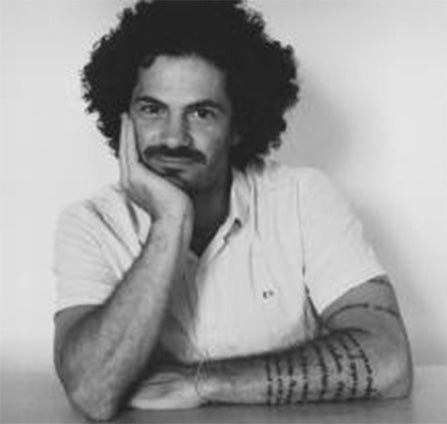
Originally from Brazil, Augusto Britto is a Ph.D. candidate at the University of Versailles-Saint-Quentin-en-Yvelines in Paris. Since 2019, he has lived between Portugal, Spain and France — a migratory experience that has become a central theme of his academic research and an essential part of his identity.
“I think it adds value for a French institute to send someone who is not French into this experience,” Britto said. “We are bringing a third culture, country and perspective into the game. I left Brazil seven years ago, and this has shaped both my decision-making and the way I perceive things.”
He holds a master’s degree from Université Paris-Saclay, awarded with an excellence scholarship, where he researched the European exile of Brazilian author Jorge Amado (1948-1952). Britto has participated in conferences and publications in several countries, contributing to research projects on exile and cultural circulation. He is a musician, writer and cultural history researcher currently pursuing a doctorate on international literary networks and the role of PEN International during the Cold War.
“Certain history of PEN International isn’t well documented — one layer of my work is archival once I have access to those documents,” Britto said. “The Harry Ransom Center just had an exhibition on PEN International. I talked to the curator of the exhibition, Dr. Marion Wynne-Davies from the University of Surrey in England, which was really interesting.”
He added, “During the time frame I am researching, the CIA meddled into the [PEN] organization. The curator shared an article on that and says there are documents that have not been worked on and remain at the Harry Ransom Center. I am quite enthusiastic about that.”
Joint Symposium Marks Inflection Point
In November 2025, Texas Global and the IdA consortium hosted "Transatlantic Ties and Opportunities in a Transformative Age," a joint symposium on the UT campus that connected distinguished scholars and partners from UT Austin and France to examine the shifting dynamics of international relations.
“This was the first symposium we hosted,” Feigenbaum said. “We were truly delighted, because it was a representation of the evolution of our relationship with the Institut des Amériques.”
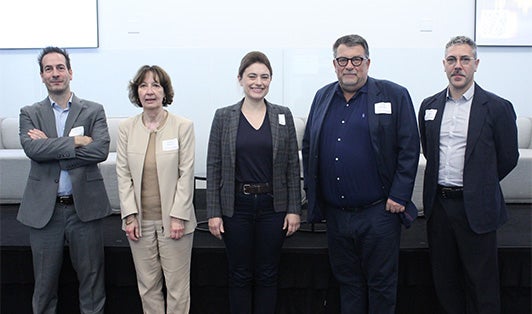
The 2025 symposium — hosted in collaboration with Aix-Marseille Université, Université Sorbonne Nouvelle, Université Paris-Nanterre, Institut de Recherche Stratégique de l'Ecole Militaire, École Normale Supérieure de Lyon — allowed seven scholars from France and several UT scholars to present their research and engage in dialogue in a true integration of work from both sides of the Atlantic.
“That was a real turning point for us because each fellow was tasked to be UT Austin’s liaison in serving as a connecting point with institutions back in France,” Feigenbaum said. “It also gives fellows the opportunity to conduct and share research at symposia that are oftentimes related to their work or the work of other scholars and fellows at partner institutions.”
Shifting her sights to 2026, she hopes for faculty members to attend and present at the IdA’s biennial congress, another vision she remains optimistic about due to the conversations that resulted from the 2025 symposium.
Advancing Global Engagement
“Global engagement at The University of Texas at Austin is an inherent part of the success of the institution, and it's multipronged in the way that we work in international education,” Feigenbaum said. “One of the aspects of global engagement is the cultivation of partnerships with institutions of higher education, research centers, governments both local and international, and with the connection between where we sit here, in Austin, Texas, and the diasporic populations of the various countries with which we engage.”
It is instrumental, she noted, for institutions of UT Austin’s stature to evaluate partnerships and ensure that alignment exists with the University’s vision and strengths.
Feigenbaum concluded, “In advancing the various missions of the colleges and schools across the institution, we then look at it holistically to connect the dots and see the multiplying effects of engaging with institutions and countries around the world.”