Passport to Possibility: Inspiring Global Careers
- Nov 20, 2025
- Education Abroad
- by Ellen Stader


Assistant Professor of Instruction Jennifer Fritz has spent nearly 30 years advocating for international education at The University of Texas at Austin, offering students culturally immersive experiences that combine academic rigor with the numerous benefits of studying in a different country.
“We know study abroad builds a lot of resilience and self-awareness. It helps really good students stand out in a highly qualified field [of applicants],” said Fritz. “Many of my students go on to other study abroad programs. It changes their careers.”
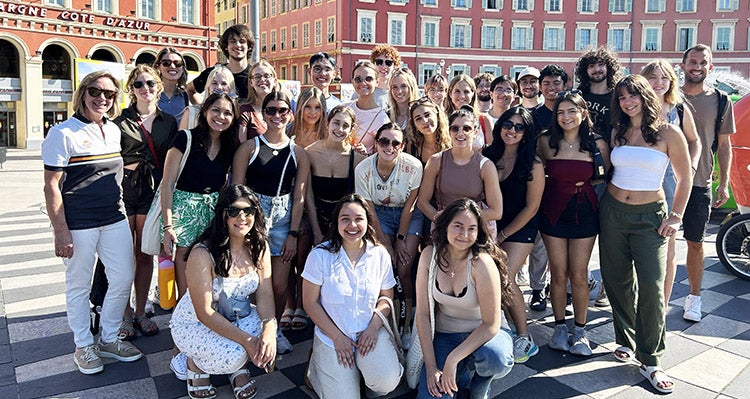
In 2020, Fritz launched “Introductory Biology in the South of France,” a popular May Term course in Nice that blends classroom instruction with cultural exploration. In 2026, she will leave that course and transition into teaching a Summer program, titled “Evolution: An International and Cultural Perspective,” in Seville, Spain. Professor Mark Bierner recently retired from teaching the faculty-led course, which he had overseen since 2012.
Worldwide Opportunities for Longhorns
With May Term and Summer courses, UT invites students to step beyond the classroom and participate proactively in a broader world.
Courses run 3-10 weeks, providing short-term, high-impact opportunities for Longhorns to study abroad. Powered by Texas Global and led by UT Austin faculty, the programs respond to the needs of students who want to engage deeply within their fields of study in a multinational context.
Programming is immersive and intensive, facilitating in-depth academic and cultural explorations that span disciplines and locations across the world. Course topics can range from global health in Costa Rica or government policy in Australia’s Great Barrier Reef to Ottoman history in Turkey or documentary photography in Ireland — to name only a few options.
Intercontinental Influences
Fritz’s track record in worldwide education began in her school days. At age 13, her father took a job in Barcelona, and her family moved to Spain for several years.
“My own experience of moving overseas at a very young age ... was just life-changing,” Fritz recalled. “My resulting love of travel, adventure and languages is a big driver for me.”
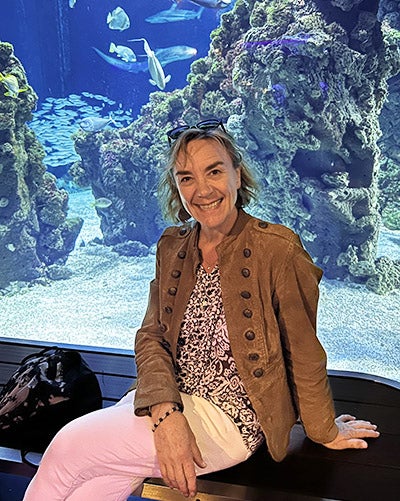
Her time in a host teacher exchange program in Grenoble, France, and a stint teaching at The American Embassy School in New Delhi, India, further whetted Fritz’s appetite for facilitating international education.
After earning her Ph.D. in botany at UT in 1997, Fritz began teaching in the Biology Instructional Office in 1998, lecturing and developing curriculum for introductory biology, UTeach, OnRamps, and related courses in the College of Natural Sciences. Later she added a TEA Science Secondary Certification and International Baccalaureate teaching certification to her credentials.
Fritz pursued teaching encounters that ranged widely, from teaching non-majors to majors-level bio in the evolving biology office as well as classes in the College of Education. In 2020, she devised an effective way to combine her love of teaching with her lifelong globetrotting urge.
Global Scholastic Gains
Fritz’s May Term course in the seaside city of Nice (to be led in 2026 by Professor Sata Sathasivan) focuses on sea urchin fertilization and ascidian development. Experiential fieldwork activities include observing pollinator ecology at nearby castle ruins, snorkeling to view aquatic ecosystems and visiting the nearby Oceanographic Museum.
“The south of France is really ideal for studying ecology, evolution, the whole biology hands-on experience,” said Fritz.
A key feature of the course is its proximity to the Institut de la Mer de Villefranche (IMEV), affording participants rare access to a working marine research station. Students work at IMEV to collect plankton, dissect invertebrates, study fertilization and observe cell division under a microscope.
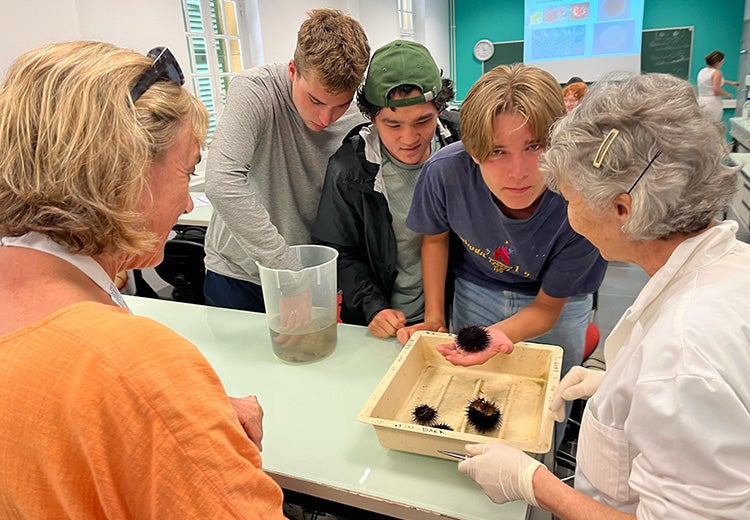
She described the moment students connect theory to practice: “Literally, they're holding these sea urchins in their hand, and then they look in the microscope and see, well, urchins divide this way, but this other gooey thing divides that way. I hope that's a big a moment of understanding that might stick with them.”
During these studies, students interact daily with professional scientists, gaining firsthand insight into the scientific community — another critical aspect of the experience.
“Going to the IMEV, we lunch with the researchers in the station canteen. We see what their day-to-day life is like. We see that they can't park at work, either!” Fritz joked.
She also praised the region’s legacy of public respect for scientists and the value of their work, presenting an important example for aspiring researchers to witness.
“France honors its scientific history. It has a long history of [celebrating] naturalists and their collections,” she said, recalling an unforgettable moment. “Outside the metro, all along the gates of the Jardin Alsace Lorraine metro station and park, are huge posters of scientists. There were eight posters in a row of local Nice scientists — big, like rock stars! Up there for students to see!”
Structure Supporting Growth
Using her background in curriculum design, Fritz has taken her course well beyond biology by creating an experiential group project that helps students step into professional roles and accept full accountability for their work.
“My only request is that [the project’s topic] has to do with the biology we're learning, which is quite broad; has to do with something in France; and has to be dear to their heart,” she said.
The students work in groups of five, dividing roles between one manager, two designers, and two researchers; each role comes with responsibility — and a chance to lead. Students accept the inherent responsibility in their roles, carrying out their specific duties for the duration of the project.
“If a student chooses to be the manager because they ‘want it done right,’ that comes with a level of responsibility that's a big part of the experiential project,” Fritz explained. “It's also fun. The students love taking on their individual roles, and they take complete ownership.”
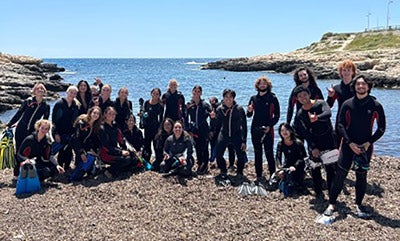
These projects don’t just build knowledge; they build portfolios. Fritz then encourages students to showcase their work in interviews.
“If they call themselves a designer, a researcher, a manager, that’s something they can take to their recruiter,” said Fritz. “They have a list of skills they've learned as a result of taking part in the project, and this is now marketable: ‘Here's the project we made; this was my role in it.’ ”
Strategic Advantages of Study Abroad
Fritz believes transnational education gives students a competitive edge — and a compelling story to tell.
“I know students are incredibly stressed-out [wondering], ‘How am I going to stand out?’ ” said Fritz. “Freshmen think it's a 4.0 GPA, and they spend too much time working for free in these leadership roles, but that ain't it. It's working overseas, for example — what we do there is what gives them something to talk about and makes them stand out.”
As proof of this conviction, Fritz mentioned the many successes she’s witnessed over years of running faculty-led courses — students launching into careers across the globe after securing prestigious grants and fellowships.
“My TA was awarded a Chateaubriand Fellowship in 2022, when they accepted 57 out of something like 600 applications,” Fritz said, recalling one triumph in particular that hit close to home. “Her quality work at UT was her commitment to a global research connection between The University of Texas and France.”
Fritz revels in her students' auspicious stories, admitting, “I’ve been shocked, frankly, at the quality and achievements of some of the students who have been [through my program].”
She offers up her decades of dedicated work in the name of broadening opportunities for academic and cultural understanding, concluding with an emphatic grin, “That's why international education is important!”
More About May Term, Summer Courses
May Term programs take place during the May sub-term of the spring semester. Full-time undergraduates pay no additional tuition for their May Term abroad course, and credits earned don’t count toward the 17-credit enrollment cap. That means more learning and less stress.
For information about where a May Term or Summer program could take you, explore Education Abroad's full list on the Faculty-Led Programs page. Find details of course summaries, faculty instructors, costs, dates, deadlines, and contact info for program coordinators.