Medical Students Share Takeaways from Global Community Health Exchanges
- Sep 15, 2026
- Sarayu Adeni, Dell Medical School


When four medical students from different corners of the world crossed paths in the United States in 2026, they shared details from their respective journeys. At two global health conferences, Dell Medical School students Zahra Ansari and Alia Pederson connected with Kenyan and Mexican counterparts from Academic Model Providing Access to Healthcare (AMPATH) partner institutions.
AMPATH is a partnership model for global health that leverages academic medical centers — like the one at The University of Texas at Austin — to respond to the health needs of local populations. UT Austin’s Global Health Program currently participates in both AMPATH in Kenya and MAPAS (Spanish translation) in Mexico.
Ansari, then a third-year medical student at UT, met Kevin Kiplangat Kiprono from Moi University in Eldoret, Kenya, at the annual conference, Consortium of Universities for Global Health in Washington, D.C.
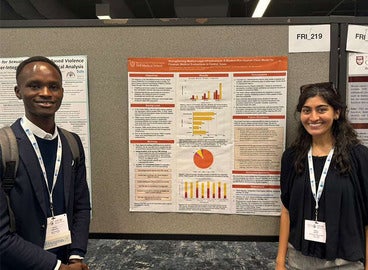
“It was a brief but meaningful interaction,” said Ansari. “We exchanged insights about our presentations and shared our experiences at the conference. It was a great reminder of the global connections this field fosters.”
Ansari presented “Strengthening Medico-Legal Infrastructure: A Student-Run Asylum Clinic Model for Forensic Medical Evaluations in Central Texas,” while Kiprono presented “Bridging the Post-Discharge Gap: Leveraging Community Health Workers in Kenya,” drawn from his fall 2025 experience in Austin during an AMPATH clinical exchange rotation at Dell Med.
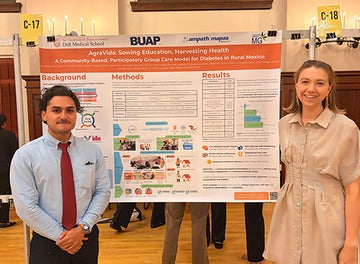
Pederson, then a fourth-year med student, was joined in Austin by Carlos Fernando Ramirez Razo, from the Benemérita Universidad Autónoma de Puebla (BUAP) in Puebla, Mexico, at the Interprofessional Health Showcase at UT. Together, they presented “AgraVida: Sowing Education, Harvesting Health — A Community-Based, Participatory Group Care Model for Diabetes in Rural Mexico,” drawn from work completed in Puebla. Pederson participated in this longitudinal project during her exchange rotation in February 2026.
The students reflected on the lessons they’ve learned during their respective journeys in global health.
How has your experience impacted your interest or perspective on global health?
Razo: This experience significantly strengthened my interest in global health. It highlighted how collaboration across countries and disciplines can lead to more culturally appropriate and sustainable interventions. It also reinforced the importance of implementation science in bridging the gap between knowledge and real-world practice.
Kiprono: It expanded my understanding from a primarily clinical focus to a broader systems-based view, emphasizing the importance of health system strengthening, interdisciplinary collaboration, and sustainable innovation. I gained a clearer appreciation of how research, policy, and community engagement intersect to shape health outcomes. This has strengthened my interest in contributing to global health not only as a clinician, but also as a researcher involved in developing and evaluating scalable interventions.
What challenges did you encounter while presenting your global health work at these conferences?
Ansari: A challenge I encountered was presenting to audiences with varying levels of medical knowledge. I had to be intentional about minimizing jargon and clearly explaining concepts, particularly given how acronym-heavy the field of asylum medicine can be.
Kiprono: The conference environment was intellectually demanding. Being surrounded by highly accomplished researchers initially felt overwhelming, but it ultimately encouraged me to engage more actively, ask questions and contribute to discussions.
Was there a specific point you were excited to share with event attendees?
Ansari: One of the biggest highlights was meeting individuals from across the global health space, especially those representing such a wide range of countries and backgrounds. I was most excited to share how student-run initiatives can help expand access to forensic medical evaluations for asylum seekers, while also building sustainable, interdisciplinary partnerships within the community.
Razo: What I was most excited to share was how AgraVida integrates community voices into the design of a diabetes care model. The participatory approach, combined with group care and the involvement of “promotoras,” really resonated with attendees ... We had thoughtful conversations with people from different disciplines who were interested in implementation science and community-based care.
Distilling complex projects to share widely with others is difficult, but also a highly motivating experience. What were your big takeaways?
Razo: Effective global health work requires humility, adaptability and genuine partnership with communities. I also learned that solutions must be co-created, not imposed, and that context is everything when designing interventions.
Pederson: Above all, I think the most important thing is the gratitude I feel for the opportunity to be here and to learn. What a privilege to work in such an open environment, where we dedicate so much time to reflecting on our new experiences as healthcare providers. What a joy it is to get to know one another, support each other and learn from one another. I will carry this with me throughout my entire career.
Tell us about connecting with your AMPATH colleagues. Any fun moments?
Pederson: Overall, my experience during the elective [in Puebla] was excellent. The first thought I had when I won the Leah J. Dickstein, M.D. medical student award with a scholarship was, "Great, now I can go back to MAPAS!"

Razo: From the moment I arrived at UT Austin, the Dell Med students made me feel genuinely welcomed — they created an environment where I didn’t feel like a visitor, but rather like a colleague and friend. That openness made it easy to have honest conversations about healthcare systems, the role and moral responsibilities of physicians, and broader cultural perspectives. One fun memory was learning how to dance two-step with them at the Broken Spoke; it was a great cultural moment that made the exchange even more memorable.
What advice do you have for other students from your institution who want to share their global health work or participate in exchanges?
Razo: I would strongly encourage students to fully engage with both the academic and cultural aspects of the exchange ... Take the time to understand the local context. The relationships you build are just as important as the academic work.
Kiprono: Be open to feedback, actively engage with other participants, and take advantage of the diverse perspectives present at the conference. Importantly, approach the experience with confidence in the value of your contribution.
Ansari: Step outside your comfort zone and take the opportunity to connect with as many people as possible. You never know what meaningful conversations or opportunities might come from it.
Pederson is now a first-year psychiatry resident at Columbia University in New York City. Ansari will graduate from Dell Med in May 2027 with plans to pursue dermatology. Kiprono is completing his final years of medical school at Moi University in Eldoret and will pursue neurology. Razo began pursuing his master of public health at the National Institute for Public Health in Mexico and will continue working with AMPATH/MAPAS.