Rooted in Resilience: UT’s Dalai Lama-Blessed Bodhi Tree Continues to Connect
- Jan 30, 2026
- by Alex Briseño


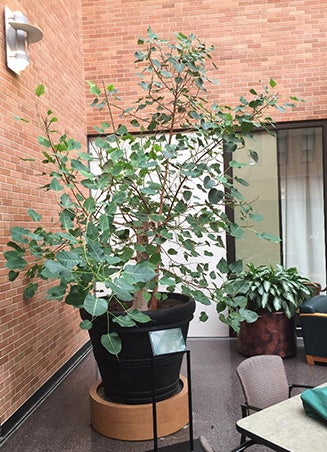
Residing in the Presidential Lounge on the third floor of the University Union, a Bodhi tree commemorates the campus visit of Tenzin Gyatso, the 14th Dalai Lama, who delivered remarks to a crowd of more than 12,000 at the Frank Erwin Center on September 20, 2005.
More than 20 years have passed, and marketing professor Dr. Vijay Mahajan can still recall the energy on campus during the historic visit.
“The campus community was very much excited for the Dalai Lama’s visit, which was organized entirely by University Unions Director Andy Smith,” Mahajan said. “We thought it would be nice to commemorate the delegation visit by planting a Bodhi tree as a gift of enlightenment to campus, to have a symbol that will survive him and survive all of us.”
The day after the Dalai Lama spoke at the Frank Erwin Center, His Holiness stood alongside Mahajan, Smith, Richard Lariviere, then-Dean of the College of Liberal Arts, students, family, friends and “good-hearted donors,” as he concluded his two-day visit with a blessing of the tree.
Recognized by its heart-shaped leaves, the Bodhi tree represents deep connections as a Buddhist symbol of enlightenment and wisdom.
“This is the tree of enlightenment, and I cannot think of a better place for one than at a university, where it can be a symbol to students, staff, faculty and campus visitors that we stand for enlightenment,” Mahajan said. “This is the symbol of Siddhartha Gautama — the Buddha — who stood under this tree and dared to ask, ‘Why are we here?’ and ‘Why do so many suffer?’ ”
Mahajan added, “If this guy had a problem, that means we all have a problem! But he achieved enlightenment and delivered a smart message: Do not get attached.”
What Mahajan didn’t know was that the tree’s mere existence on campus would test that very practice of non-attachment. And few others know that long before the 20th anniversary of its blessing, celebrated in fall 2025, the Bodhi tree skirted death after enduring eight years at the Union without a single inch of root growth.
A University-wide Effort
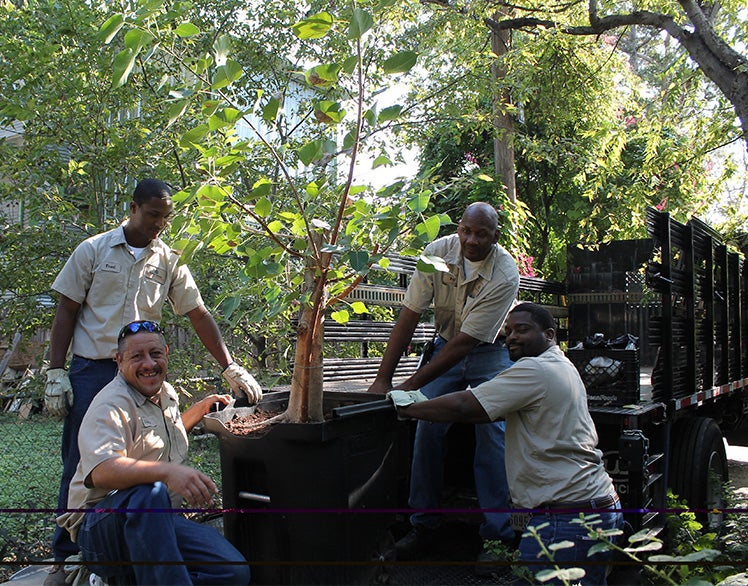
The tree’s journey back to health required heroic acts and serendipitous connections across campus, including multiple relocation efforts, the pro bono services of local “tree whisperer” and longtime UT staff member Robert Moddrell, plus a dedicated community of Longhorns and extensive efforts from Landscape Services, including Ty Kasey, who have all helped nurture it throughout the last two decades.
“This tree would not be alive without Bobby,” Mahajan said.
Moddrell joined UT in 2005, just two months after the Dalai Lama’s visit. Over 16 years, he served in roles including assistant director of University Unions and manager of Resource Recovery, where he led UT’s Zero Waste Program. What his LinkedIn profile won’t disclose is his lifetime gig as UT’s Bodhi tree consultant. Even after retiring from the University in 2022 — and certainly without a budget line item for “Bodhi tree steward” on the payroll — Moddrell returns weekly to check on the tree.
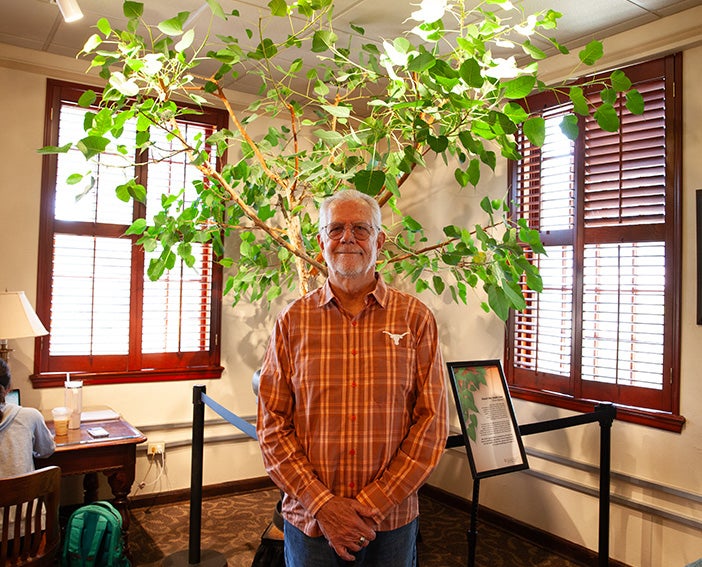
“I come in and take a look at it, make calls if I need to,” Moddrell said with a grin. “I have about a million photographs, so I also make sure to take a picture each time.”
It wasn’t until 2013, when Moddrell started working as the assistant director of University Unions, that the tree entered his orbit. Smith, his supervisor and longtime executive director who spent 27 years with University Unions, informed Moddrell that the Bodhi tree was sick.
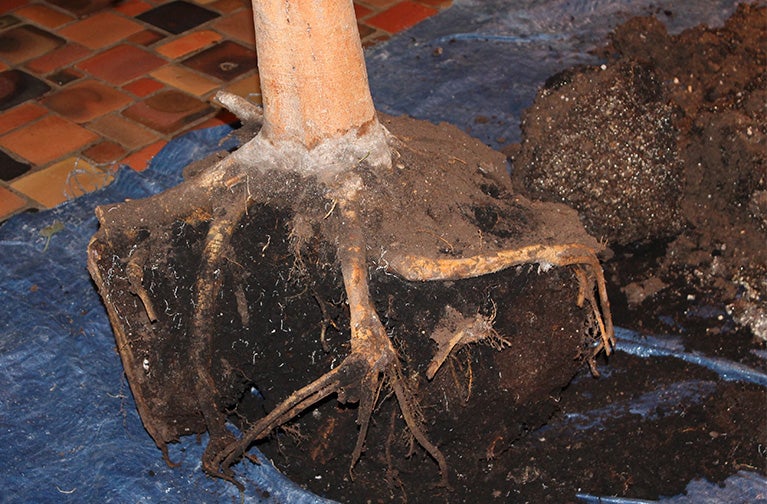
The bleak reality of eight years passing without a single inch of root growth didn’t discourage Moddrell, though — at least not enough to dissuade him from attempting a tree-saving operation. Mahajan was shocked that the tree endured without growth for that long. Far more uncertainty surrounded the tree during its 10-year anniversary than during this year’s, he noted.
“There were many sleepless nights when I was miserable about the state of this tree,” Mahajan said.
In Moddrell’s case, this crisis presented an opportunity to serve multiple communities he loved and felt indebted to.
“I have a personal relationship with the Dalai Lama’s teachings that goes back 50 years, so that has been a big part of this experience,” Moddrell said. “By the time I started taking care of the tree, I had a love for the University, too. I felt obligated more than anything, because it was an unusual opportunity to serve such a unique purpose. It was clearly time to serve.”
Saving a Bodhi Tree: Step One
Moddrell began rescue efforts by hiring the Davey Tree Expert Company from Houston to remove the tree from its original location and assess its condition. The assessment immediately made it clear that the tree could no longer remain in the Presidential Lobby; the towering ceilings would continue to prevent the proper amount of light from reaching the tree.
The most difficult portion of the diagnosis for Moddrell was discovering that the top part of the tree had died and needed to be removed.
“That was heartbreaking, and I think it really changed the tree’s future location opportunities,” Moddrell said. “And it changed the tree. It didn’t have the same silhouette or aesthetic.”
The cuts had to be made, though, and they were right before the first winter under Moddrell’s care.
“I asked if I could take it home,” Moddrell said. “I didn’t live very far from here at the time, so I spent about a year with it at my house. I had to harbor it over the winter in one of those tiny garages in Hyde Park.”
One Winter in Hyde Park
The tree arrived at Moddrell’s residence in a rolling trash bin with the help of UT’s Facility Services team.
“We needed a way to move a 400-pound item in and out of the garage, and that did the trick,” Moddrell said.
His morning routine included a prayer with the tree followed by meditation. Heating and lighting both posed a “bit of a problem” when winter arrived, he still admits.
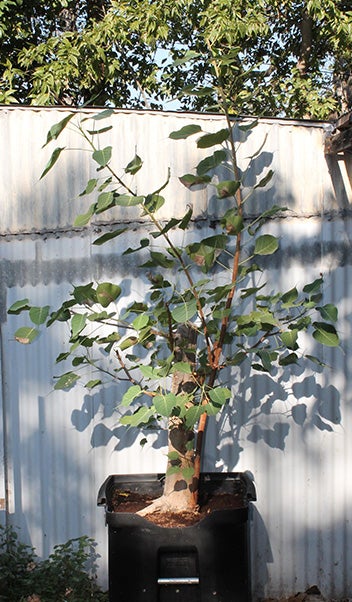
“That was scary,” Moddrell said. “I had heating, artificial lights. I ran in and out with a temperature gauge anytime it got cold.”
His efforts seemed to be working, though, as all signs began pointing toward a recovering tree. This became even clearer when Moddrell noticed a new sprout.
“I viewed it as reincarnation,” he said. “But I knew I had to find somewhere for it to go before the following winter, because the way I was able to keep it going that first winter was a little sketchy.”
Moddrell, Mahajan and Associate Professor Emerita Janice Leoshko pushed for a future that included the tree’s return to the Forty Acres.
“We insisted the tree come back, and so that's how it ended up back at the University,” Moddrell said. “We felt it was critical that the Bodhi tree come back in honor of the Dalai Lama’s visit, and because it has a purpose here.”
Finding the right campus location, however, would prove to be yet another labor-intensive assignment.
By Moddrell’s estimation, there were seven units involved with relocation efforts, including Grounds and Landscape, Moving Services, Facilities Services, and Events and Entertainment, whose efforts intertwined.
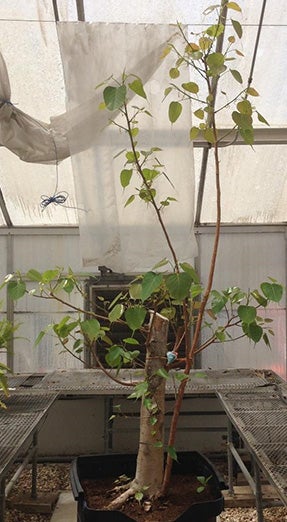
And that’s not even considering the countless faculty and staff who assisted at one point or another in the last 20 years. Beginning in 2014, the tree flourished and did most of its growing under Kasey’s care in the on-campus greenhouse at the Facilities Complex on Manor Road across Interstate 35.
Susie Brown, then-associate dean at the McCombs School of Business, welcomed the Bodhi tree into their atrium in 2017, a stay which was short-lived due to the UV filter in the business school’s skylights. The tree also spent time at the Pickle Research Center greenhouse before making its long-awaited return to the Union in 2023.
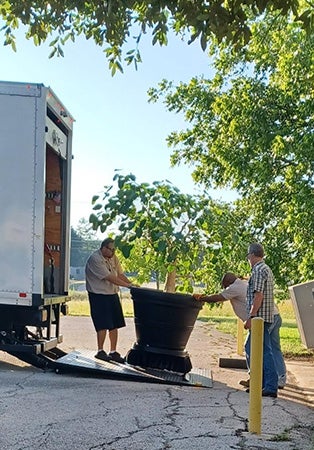
“There is a happiness that the tree is home, where the Dalai Lama originally blessed it,” Moddrell said. “Our goals for the tree were lighting, care, for it to get institutionalized — for it to be a line item [in the University budget] — and that it be accessible to students.”
The tree has all of that now thanks to Mulu Ferede, executive director of the University Unions.
“Mulu deserves a lot of the credit for that,” Mahajan said. “He decided to make it a line item, which was a huge deal because it meant that the tree found a home. From there, Bobby developed all of the estimates for the cost required to care for the tree.”
Blessings in Disguise
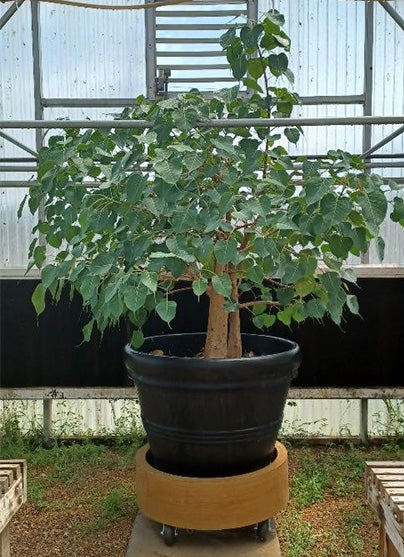
With the benefit of their new, hard-won certainty regarding the tree’s current health, Moddrell and Mahajan both view the recent 20-year anniversary of the tree’s blessing as a conduit to reflect on the 2005 visit, as well as the many ongoing lessons learned from the tree and the man who blessed it.
“This symbol is important, and it’s steady,” Mahajan said. “We get a lot from this University, and so all of us on campus are invited to pay it forward. Whether we become architects, philosophers, engineers, whether we get a Ph.D. or go to business school, this tree extends that invitation to give back.”
As for Moddrell, more than a decade has passed since he signed up for what he originally thought would be a one-year process. And still, he considers it all joy. It’s what will keep bringing him back to campus roughly once a week for the indefinite future.
“It’s been a real blessing for me. I’ve learned a lot from just being associated with it,” Moddrell said. “This tree brought me a wonderful person, Vijay, whom I have really enjoyed getting to know. We still get lunch every couple of months. That pairing never would have formed had it not been for this tree. It’s a lifelong friendship, and I consider it a gift from the tree.”
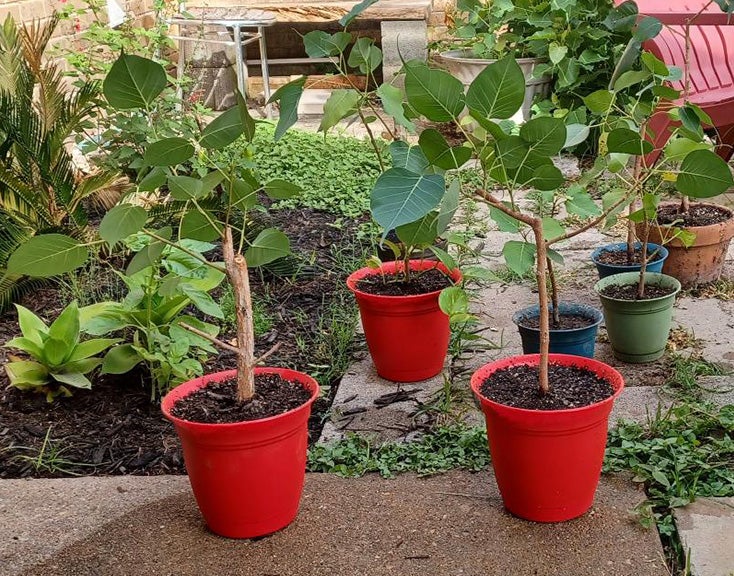
Moddrell points out that it will need to be trimmed in the near future. Otherwise, the tree is thriving.
It has even provided numerous cuttings, including one to Mahajan’s daughter and another to his daughter-in-law. Moddrell gifted one to Ben Reid, facilities manager of Bauer House, the official home of the Chancellor of The University of Texas System.
From Moddrell’s gift, Reid made another two cuttings, both of which currently reside in Bauer House.
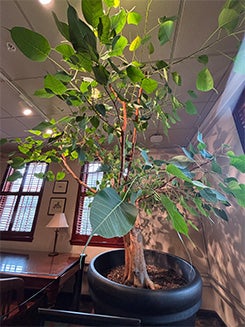
Contributors to the Bodhi tree’s cause branch out across a multidisciplinary group of Longhorns from all corners of campus, creating what Moddrell describes as a cross-cultural experience that connects with new students every day.
“I get questions from all types of students whenever I come in and take photos. I hear how they appreciate the symbol of this tree, the idea of peace, calmness, serenity, meditation,” Moddrell said. “You don’t have to have a conduit, but it’s nice to have, and this one has a lot of history that I think all Longhorns should be really proud of.”