Drama Program Transforms Education on Five Continents
- Sep 17, 2025


Drama for Schools, a program launched at The University of Texas at Austin, is now globally recognized for using arts-based strategies to engage students and transform teaching. It’s a flexible, research-driven framework that’s been used by educators on five continents. And now, it’s the subject of a new book titled, “Drama for Schools and Beyond: Transformative Learning Through the Arts.”
At the heart of both the program and the book is Katie Dawson, the program’s founder and an associate professor in UT’s Department of Theatre and Dance. "We write the books we need," Dawson said. "This one was about pausing to look back at 20 years of impact — locally, globally, and as a research contribution."
Backed by a team of experts who bridge education and theatre, Drama for Schools continues to expand. Dawson leads the program’s research and practice efforts alongside Lara Dossett, assistant professor of instruction in Theatre and Dance, and Stephanie Cawthon, professor of educational psychology and director of research and evaluation. Together, they train educators not just to use arts-based methods but also to become leaders who can train others, building long-term capacity within schools and communities.
Core strategies include visual art, role play, movement, and collaborative problem-solving, all designed to engage students intellectually, emotionally and physically. This adaptability has made Drama for Schools globally relevant.
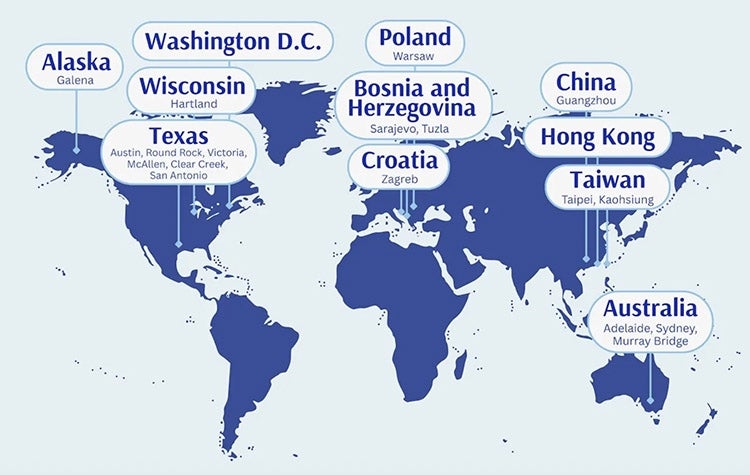
In Alaska, the team worked with the Koyukon Athabascan community to support culturally grounded education and healing after a youth suicide crisis. In Australia, they partnered with the University of South Australia and its Department for Education to incorporate drama into math instruction — especially in ways aligned with Aboriginal knowledge systems.
Dawson was also invited by the U.S. State Department to lead multiyear teacher training initiatives in Croatia, Bosnia and Herzegovina, and Poland — countries with complex histories of conflict. There, drama became a tool for intercultural dialogue and social cohesion.
"The Drama for Schools training program resonated particularly well in Bosnia and Herzegovina, where there is a strong demand among educators for more inquiry-based and student-centered teaching that fosters higher-level thinking skills," said Holly Zardus, cultural affairs officer with the U.S. Embassy in Sarajevo. "I saw this program transform them."
Beyond workshops and classrooms, Drama for Schools has built one of the most widely used educational resources from UT’s College of Fine Arts: an open-source website offering videos, lesson plans, and more than 100 strategies — visited by educators around the world since it launched in 2009.
To learn more about Drama for Schools, visit the Bridging Barriers website.