Clements, Strauss Centers Host Global Voices on Future of International Security
- Jun 18, 2026
- Clements Center for National Security


The sixth Texas National Security Forum brought together scholars, policymakers, and practitioners at The University of Texas at Austin in November 2025 to focus on the instruments of American power beyond the military.
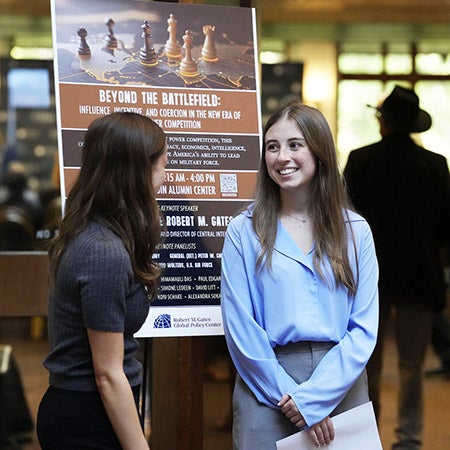
Hosted by the Clements Center for National Security with the Robert M. Gates Global Policy Center and the Strauss Center for International Security and Law, the daylong conference, titled "Beyond the Battlefield: Influence, Incentive, and Coercion in the New Era of Great Power Competition," returned to UT after a five-year hiatus.
“Universities have a unique role to play in ensuring that the full range of tools that sustain American leadership are understood, debated and strengthened,” said Executive Vice President and Provost William Inboden. “Through programs like the Clements Center for National Security and the Strauss Center for International Security and Law, we are preparing the next generation not just to study policy, but to shape how the nation approaches security, diplomacy and global leadership.”
The forum's discussions covered diplomacy, economic statecraft, intelligence, emerging technology, and development assistance — and the question of how each contributes to U.S. leadership without an overreliance on military force.
The program reflected a broader collaboration across the University, drawing faculty, fellows, and program leadership from the LBJ School of Public Affairs, the College of Liberal Arts, and the School of Law.
It brought students, faculty, policy professionals, and Austin community members to the Etter-Harbin Alumni Center for a series of conversations with leaders whose careers span North America, Europe, Asia, and the Middle East.
The Return of Strategic Competition
Former Secretary of Defense and Director of Central Intelligence Robert M. Gates opened the morning onstage with Inboden, himself a former director of the Clements Center.
Gates’ keynote address surveyed the global security landscape, including Russia's war in Ukraine, the Moscow-Beijing partnership, U.S.-China economic interdependence, and the future of America's alliances, and argued the country has lost ground on the non-military instruments of power that helped win the Cold War.
China is now the largest trading partner of more than 120 countries and holds Belt and Road agreements with roughly 150, he said. Its global media presence has expanded into nearly every country, while the United States dismantled the United States Information Agency in 1998 and shut down the international broadcasting network Voice of America earlier this year.
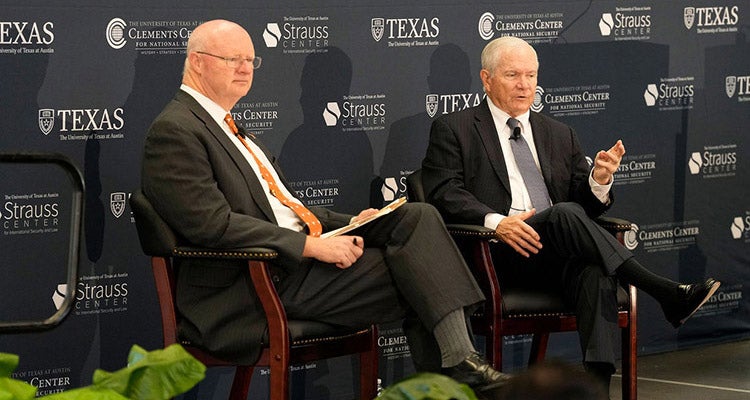
On rare earth supply chains, Gates said China controls roughly 70 percent of global supply and approximately 95 percent of refining capability. When Beijing cut off battery exports earlier this year, he said, Ford Motor Company came within a week of shutting down production.
The work, he argued, is strategic de-risking: building refining capacity at home and with allied partners. Asked at the close of the keynote what he would tell students considering a career in national security, Gates was direct: "My main advice would be: Do it. The country desperately needs you."
"What is needed is a much more creative approach to blending the capabilities of legacy programs that still have value and new technologies."
— Robert M. Gates
Following the keynote, Kori Schake, senior fellow and director of foreign and defense policy studies at the American Enterprise Institute, joined Clements Center Deputy Executive Director Paul Edgar for a conversation on American leadership and the health of U.S. national security institutions.
Schake, a former member of the National Security Council and State Department Policy Planning Staff, addressed the value of a nonpartisan military and the professionalism and civic trust that have long defined it.
Schake also pointed to the role universities and policy research centers play in strengthening national security by producing clear analysis and preparing the next generation of leaders. She encouraged students to take full advantage of the resources and mentorship available to them while at UT.
Commanding Beyond Combat
A keynote panel of three retired four-star officers, moderated by Clements Center Associate Director Angelica Martinez, examined the evolving role of emerging technology in U.S. defense posture.
The panel featured Gen. (Ret.) Vince Brooks, former Commander of U.S. Forces Korea and a Distinguished National Security Fellow at the Clements and Strauss Centers; Gen. (Ret.) Peter W. Chiarelli, 32nd Vice Chief of Staff of the Army and President of the Robert M. Gates Global Policy Center; and Gen. (Ret.) Tod Wolters, former NATO Supreme Allied Commander Europe.
The panel agreed that integrating emerging technology into U.S. strategy presents real opportunity but also requires consideration of broader societal impact. Chiarelli noted that continued medical innovation remains essential to the care and safety of troops and veterans.
He also described a notable shift since his service in Iraq: U.S. corporations and foundations have increasingly brought non-military capability to the battlefield, supporting Ukraine with everything from forensic tools for police investigation to mobile hospitals and prosthetics.
Tools Beyond the Battlefield
Three afternoon panels turned to specific instruments of statecraft. Strauss Center Director Adam Klein moderated a panel on intelligence and technology that examined how the United States and its allies can scale and integrate commercial technology effectively in conflict.
"To avoid using military force, we have to detect, prevent, and deter attacks," Klein said, pointing to the role of military AI, drones, and commercial chips in deterrence and detection alike.
The panel cautioned against overreliance on AI-driven prediction; the complexity of human decision-making, they agreed, still escapes the data — and a country that forgets that fact risks being caught flat-footed.
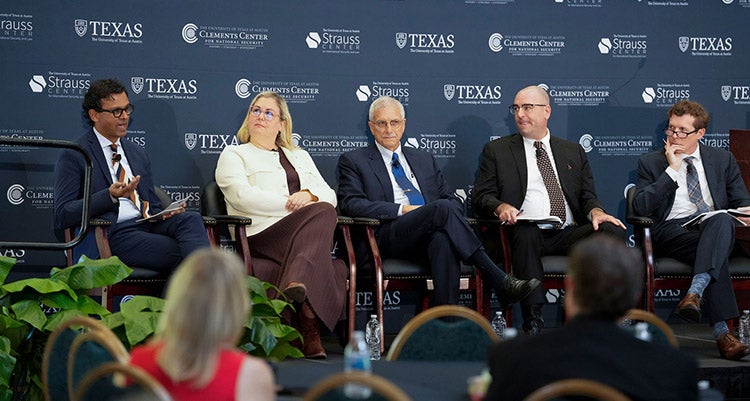
UT International Relations and Global Studies Director Michael Anderson moderated a panel on diplomacy and economic statecraft, with Himamauli Das, former acting director of FinCEN; Simone Ledeen, former Deputy Assistant Secretary of Defense for the Middle East; Ambassador (Ret.) David C. Litt, former U.S. Ambassador to the United Arab Emirates; and Vince Trovato, CEO of Global Strategies and a senior national security fellow at the Clements Center. They discussed how sanctions, financial tools, and diplomatic relationships now sit at the center of national security strategy.
The closing panel on information, development, and humanitarian assistance, moderated by Kate Weaver of the LBJ School, examined what is at stake when those tools of national power are weakened or withdrawn.
Panelists Daniel Balke, former senior policy advisor at USAID; Michael Greene, a retired senior USAID foreign service officer; and Mark Pomar, senior national security fellow at the Clements Center and former director of the USSR Division at the Voice of America, discussed how information environments and development aid continue to shape U.S. global influence.
Throughout the day, speakers returned to a common note of optimism: The talent and engagement of UT students and early-career professionals, and the agencies, fellowships and research centers where the next generation of national security leaders will do their work.
Recordings of all sessions are available on the Clements Center's YouTube channel.