Education Students Connect with Greece, Spain During May Term
- Jul 14, 2026


From the ancient ruins of Greece to the vibrant regions of Spain, College of Education students at The University of Texas at Austin extended their learning far beyond the Forty Acres in spring 2026.
Through UT’s May Term study abroad programs, kinesiology and health education students traveled to Greece, while educational leadership and policy students explored Spain, gaining global perspectives that enhanced their academic journeys.
May Term in Greece
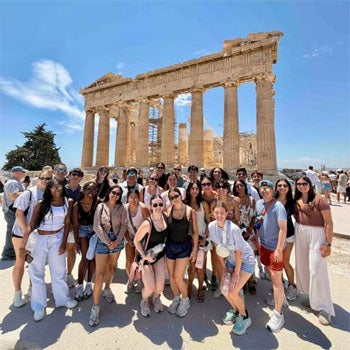
Hirofumi Tanaka, professor in the Department of Kinesiology and Health Education, led 25 students through Athens and Olympia in Greece to explore those ancient cities’ connections to modern sports, exercise and fitness.
Throughout the program, Tanaka emphasized the importance of understanding how different societies around the world experience exercise and sport. Students explored diverse approaches to athletic training, nutrition and mental preparation, also taking on challenging athletic activities such as a hike up the legendary Mount Olympus.
During a visit to the International Olympic Academy, a global center for Olympics education, students learned about the historical roots of sport and fitness at the Games. They also examined the numerous health benefits associated with the traditional Mediterranean lifestyle, which promotes long-term well-being through plant-forward diets and social connection.
Claire DeLane, an applied movement science senior, said the visit to Greece reinforced her desire to pursue a career in physical therapy.
“Comparing the different lifestyles for mainland cities like Thessaloniki and Athens to the islands and smaller towns was extremely eye-opening,” DeLane said.
May Term in Spain
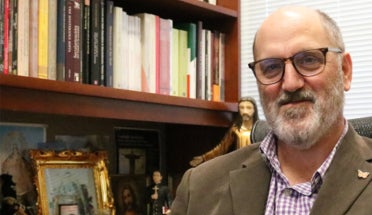
Victor Sáenz, professor in the Department of Educational Leadership and Policy, and Rodrigo Aguayo, assistant professor, led 29 Longhorns on an exploration of Spain’s rich history, where they examined subject areas such as identity, migration, language, religion and citizenship from American and European perspectives.
"Spain provides such a unique and historic backdrop, given its vast cultural heritage and the profound influence of the Spanish empire across nearly every corner of the world — for good and for bad,” said Sáenz.
While based in Barcelona, undergraduates also traveled to historic landmarks, museums, religious sites and cultural institutions in other Spanish cities, highlighting the complex intersections that continue to shape the country.
By combining academic inquiry with cultural immersion, students connected classroom concepts to broader global and societal issues. As they explored the role of culture and social context in shaping individual and collective identities, they developed a broader global perspective.
“As a faculty member, I greatly value these kinds of experiential learning opportunities for our students,” Sáenz said. “It’s incredibly rewarding to see students grow and expand their horizons while also challenging their notions of self and others around the world.”