Alumni Reflect on Humanitarian Engineering Experience in India
- Aug 28, 2025
- Education Abroad
- by Sophia Baca


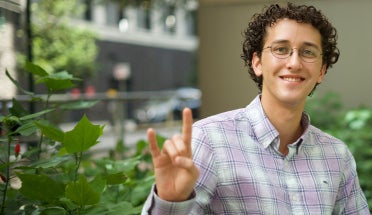
Prospective students are drawn to the Cockrell School of Engineering at The University of Texas at Austin for its rigorous coursework, groundbreaking research, and network of accomplished alumni. But UT alumni Katelyn Dill (B.S. ’23) and David Alas (B.S. ’23) believe it was the opportunity to use their skills to help communities in need that truly set them apart as Longhorn engineers.
Projects with Underserved Communities (PUC) is a program administered by Texas Global in collaboration with the Cockrell School of Engineering and the School of Social Work. Launched in 2010, PUC uses an innovative yearlong course sequence and service-learning experience to hone students’ leadership skills, technical proficiency and cultural competency.
In the program, engineering and social work students and faculty research and design a project to address a problem or need identified in an international underserved community. After developing a project in collaboration with a nonprofit partner organization in a distant locale, they travel to that community to implement the project during the summer following completion of the academic course. The program has served more than 18,300 people to date, in dozens of communities across the globe.
"The PUC program exemplifies the kind of experiential learning that changes lives,” said Thomas Ward, director of Education Abroad at Texas Global. “Students develop real-world problem-solving skills, cross-cultural collaboration experience, and a deeper understanding of social impact. These qualities shape thoughtful global citizens and give our graduates a unique advantage in both their academic pursuits and professional paths."
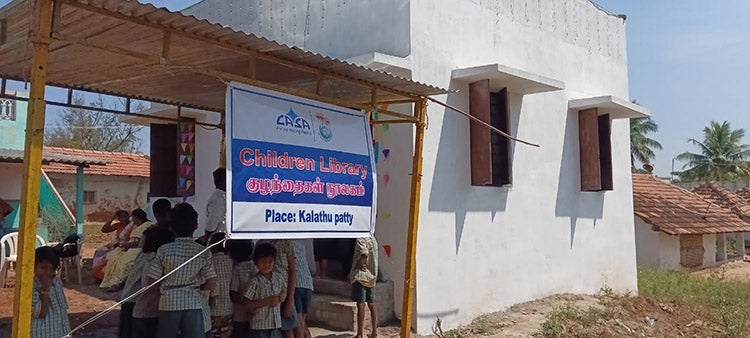
Past projects have included building a new kitchen for the Ban Thap Ta Thaen school located in the Suphan Buri Province of Thailand, installing a water harvesting system for a rural community in Tanzania, and building a solar dryer for milling mesquite pods in Mexico. Dill and Alas’ group chose to construct a children’s library and community center in Kalathupatty, Tamil Nadu, India.
“We fundraised for the project ourselves, selling coffee and donuts outside the PCL,” said Dill. “We pitched our presentation to the advisory board and got help from a bunch of different professors. It took a lot of work and late nights, but it was such a rewarding experience.”
Many Skills, One Mission
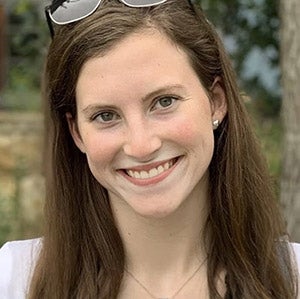
Dill, who graduated with a degree in architectural engineering, and Alas, who graduated with a degree in electrical and computer engineering, participated in PUC with “Team India” in 2022, during their junior year. They traveled to the rural town of Kalathupatty in the Tamil Nadu region of southern India, where they built the library, providing educational tools to children and internet access to the local community.
“We wanted to provide a multi-purpose space for children to learn and other individuals within the town to be able to gather and use the internet,” said Alas. “It’s a place where everyone can educate or be educated.”
In the Tamil Nadu region, more than 150,000 children are subjected to child labor, often leaving school early to help support their families. The project was chosen to create easy, free and consistent access to books and computers for these children.
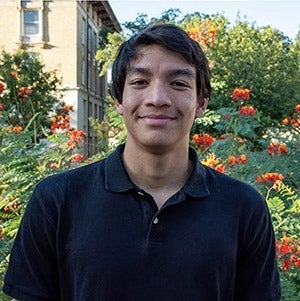
During their two-and-a-half-week trip to India, Dill served as safety coordinator and co-structural lead, using her structural knowledge to facilitate the building process. Alas was in charge of budgeting and financing the project, requiring consistent communication with local community members and Church's Auxiliary for Social Action (CASA), the nongovernmental organization they partnered with. The team also included students majoring in chemical, biomedical, environmental, and civil engineering.
“We definitely had to figure out how to play to each other’s strengths,” said Dill. “There were different components each of us could contribute.”
Co-creating with Community
PUC aims not only to build students’ technical repertoire, but also the soft skills they need in their professional toolbox. Accompanying the engineering students was a faculty advisor from the School of Social Work, whose job was to guide students through the necessary and impactful cross-cultural exchanges inherent to community engagement and local collaboration in humanitarian projects.
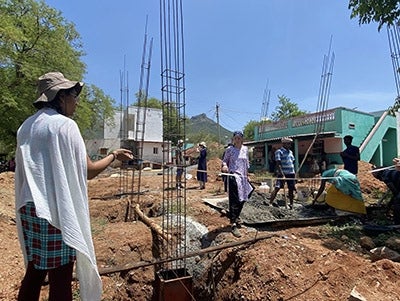
“As engineering students, we had to rethink how we approached problem solving,” Alas said. “Instead of jumping straight into a technical solution, we spent time co-creating with the community, and the end result was this children's library that came from all of us — social workers, engineers and the community.”
When Dill and Alas weren’t working on the library, they spent their time learning from the rhythms of daily life in Kalathupatty. With no Wi-Fi or running water, the rural town offered a way of life they were unfamiliar with, and the pair immersed themselves in the community that welcomed them.
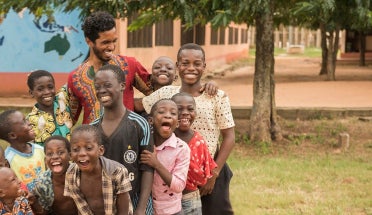
“The kids were excited to show us around. They took us to a watering hole to swim and gave us fresh coconuts and mangoes,” Dill said. “It was cool to have the opportunity to really get to know the culture and community.”
Engineering for Impact
Fast-forwarding to 2025: Dill is now a forensic engineer at Wiss, Janney, Elstner Associates, and Alas is an electrical engineer at Arup, a firm that specializes in creating sustainable and ecofriendly infrastructure. Dill analyzes building failures and develops structural and seismic retrofits that improve a building’s resilience against hazards such as earthquakes. Alas designs and coordinates electrical systems for buildings and infrastructure projects.
Although they now work in entirely different fields, both agree that the humanitarian experiences they gained in India changed their perceptions of what it means to be an engineer — and even inspired Alas to pursue his current career.
“It’s an uncommon niche for an electrical engineer to work in this industry, and I really didn’t know what I wanted to do,” Alas said. “But [Arup] is a company with good values, and I enjoyed PUC so much that it led me to do this.”
Dill echoed Alas’ sentiments, acknowledging how her experience with PUC affects the ways she engages with her everyday work, intentionally and compassionately.
“As an engineer, it’s easy to get lost in the project without thinking about how your work impacts the community,” Dill said. “But I think my experience with PUC reminds me to think about how our work impacts the people that we're doing it for.”
Besides the academic and career benefits Alas and Dill highlighted, they both emphasized how PUC created lifelong, one-of-a-kind friendships between their whole team. To this day, Alas and Dill, along with other members, still keep in touch.
“Going through that adventure in India together really solidified our friendship,” Dill said. “Even though David is in Boston and I’m in California, we still try to catch up whenever we’re back in Texas.”
PUC is open to all sophomore, junior, and senior engineering students. Applications are accepted on a rolling basis throughout the summer. When reflecting on their time as PUC students, Dill and Alas only have one simple piece of advice for prospective applicants: Just do it.
“It was my favorite class that I ever took,” said Dill. “It’s a lot of work and a lot of late nights, but just do it.”
Alas agreed wholeheartedly, expanding on the benefits he received from participating in the PUC program.
“Don’t even think twice,” he said. “You don't need any credentials; you just need a passion for sustainability and humanitarian engineering.”
Learn more about the Projects with Underserved Communities program on the Texas Global website.